Some antisocial behaviour is invisible… and Hancock the dupe…

Led By Donkeys picture of Matt Hancock

Led By Donkeys picture of former health secretary Matt Hancock

Rishi Sunak’s plan to crack down on antisocial behaviour is one of those moments when governments say, “Oh, we going to do something about those things you always say you don’t like…”

But in this case there is a footnote.

And it goes like this…

“We’re doing this because it makes a few good headlines and we haven’t got around to sorting out the things you really want sorting, like the struggling NHS, GP waiting times, the rubbish railways, schools falling apart, rampant inflation, and pot holes so deep you could lose a car down there. All the austerity we forced on you earlier made these problems worse, but we’re hoping you’ve forgotten about that.”

For his latest crusade, Sunak says he wants to tackle vandalism in public spaces. Or he wants us to think he’s doing that, which is almost the same.

Those who are caught in such acts will be “quickly and visibly punished”. That “visibly punished” refers to the wearing of shaming jumpsuits or high-vis jackets. Or maybe to the stocks and the chucking of rotten vegetables. Nothing would be a surprise.

On, and he also wants to tackle beggars causing a “nuisance” on Britain’s streets.

It’s possible he hasn’t thought through the optics on that one. Here is one of the richest men in Britain turning against people who have nothing. A modern spin on an old parable, you might say.

Yes, the sight of people begging on the streets can embarrass you into scurrying past while pretending not to look. That’s what I do sometimes, and it’s not a good trait, as public poverty should shame us all.

But it also raises another worry about crackdowns on antisocial behaviour. This isn’t just a party political point, as Keir Starmer got in first with Labour’s ideas on tackling antisocial behaviour – spurring Sunak to blurt out a few recycled ideas of his own.

The worry is this: what we are asked to regard as antisocial behaviour is confined to visible problems on the street, such as vandalism, graffiti, begging, and so forth.

Yet plenty of unseen aspects of life are antisocial. Rich people who dodge tax or employ accountants to bend the rules and avoid tax. That’s antisocial, as it denies society the means to operate.

MPs who have one well-paid job and can’t resist touting for another. That’s antisocial as they are deflected from doing their job.

We could look at any number of MPs here, but let’s consider former health secretary Matt Hancock. I know, sorry for bringing him up – and all this may want you to bring something up if you’ve just eaten.

Hancock has been claiming £13,000 a year in expenses to pay for a ‘love nest’ after he left the marital home. And after he earned £320,000 for appearing on I’m A Celebrity MP… Get Some Money In My Bank.

And that’s not even what I am talking about.

Hancock and Chancellor For A Day Kwasi Kwarteng were among MPs apparently caught out by the campaign group Led By Donkeys. In a clever stunt, the group set up a fake South Korean firm touting for business among MPs.

During an online meeting, Hancock was asked about his daily rate. A filmed clip released by the group shows him saying with shameless aplomb: “It’s 10,000 sterling.”

Ten grand a day for a side hustle. And isn’t that added “sterling” just so brattish.

Hancock’s spokesperson huffed about it having been a private conversation. Well, that’s the point.

If we are governed by politicians who have private conversations about earning ten grand a day for offering advice to foreign firms, something is wrong.

And it’s antisocial.

Also, with Sunak we have a prime minister so fantastically wealthy he has no need to use the education or health services most people rely on. Isn’t that antisocial?  Or anti the general run of society.

AS it happens, Rishi Sunak’s accountants finally released his tax statement, as long promised. The figures came out while his chaotic predecessor but one, Boris Johnson, was petulantly floundering before the privileges committee last week.

A sly move timed to go unnoticed.

Turns out Sunak made £5 million in the past three years, mostly through a US-based investments fund. As such investments are covered by capital gains tax, he paid around 22% in tax – much the same as a nurse, say.

In 2016, Sunak voted for a cut in capital gains tax – something which is estimated to have made him £300,000 in the past three years.

All of which sounds, well, antisocial.

j j j

Boris Johnson’s last stand? Braverman on tour, Brits losing out…


Boris Johnson’s official portrait when he became PM

The blustering blabber monster is back, not that he’s ever gone away, more’s the pity.

Tomorrow Boris Johnson will appear before the parliamentary inquiry into his actions during the Partygate scandal. Part of the investigation is to establish whether he lied to Parliament about the rule-breaking parties in Downing Street. Odd, as everybody knows he lied then, the lied before, and he will no doubt lie again.

The parties were held, they broke the rules – and Johnson attended them at a time when the rest of the country was in lockdown (and, incidentally, it has just been revealed that his government put pressure on the BBC to avoid using the world ‘lockdown’ in its early reports on, er, the lockdown).

Johnson’s defence seems to be that he believed he gave his honest opinions at the time. Slippery semantics, morally dubious ducking and diving – the usual Johnson swerve.  He will say that he relied on “trusted advisers” and did nothing reckless, or something.

The usual excuse: it wasn’t me.

And it’s costing us. His defence is being funded by the taxpayer to a reported cost of £220,000 – yet he is said to have earned £5 million in six months for public spouting and had enough space to buy a £4 million house. So how come we are paying for his defence, stumping up for lead counsel David Pannick and his team?

Johnson is going in lawyered up to his chin, and we’re paying for it. But then someone else always pays with that man. Richer men than himself pay for his gold wallpaper, provide homes and holidays. Newspaper owners and editors line up to back this disreputable man. And all for what, exactly? So much effort wasted on one worthless man.

In theory his appearance before the parliamentary committee could mark the end of his career as a politician, ruling out any ridiculous comeback. But the Trumps and Johnsons of this world have a way of wheedling through the moral murk they stir up. So don’t hold your breath.

HOME Secretary Suella Braverman has just returned from a curious vanity trip to Rwanda to promote her plan to send migrants to that country. Only right-wing journalists from the Mail, Telegraph, GB News etc were invited along for what it would be gruesome to call a ‘jolly’.

Yet Braverman seemed extremely jolly while she was there, releasing a picture of herself apparently laughing her head off while standing before what was said to be migrant accommodation in Rwanda. A photograph so odd and weird that it went viral on social media.

In the original picture, she is between two other people, who were then cropped out in social media posts, making Braverman seem demented (an appearance she gives with little apparent effort).

The Mail, having been invited along for the trip, hit out under the headline: “Suella’s anger over cropped picture spread by the Left on social media.”

Oh, yeah.

Two points here.

One, perhaps don’t give out publicity pictures that can be so easily turned against you.

Two, the Mail itself has a long history of cropping and altering pictures to suit its low purposes, including adding more burka to a woman’s face, as shown here (and shared by the New European).

Braverman’s trip was basically a political promo funded by us – and aimed to cause just the sort of aggravation that followed. Tediously, annoying “the Left” is the only actual policy she pursues.

All part of the morally dubious politicisation of migrants. The lives of the desperate and the disadvantaged cashed in for votes.

CHANCELLOR Jeremy Hunt, whose budget axed the pension cap to benefit the wealthiest 1% of the population, told the Commons last week: “The declinists are wrong and the optimists are right. We stick to the plan because the plan is working.”

Not according to the BBC’s Panorama programme, which showed this week how Britain is falling behind.

BBC news analysis editor Ros Atkins, quoting Torsten Bell of the Resolution Foundation think tank, said: “This is an uneasy message to hear. A typical Brit is thousands of pounds poorer than the typical German, French, Australian and Canadian. The typical American is 60% richer than the typical Brit.”

The problems go deep, but the clip below shows how often our politicians blame global problems, Covid-19 or Putin for all our problems, all to mask our wider failures. And don’t forgot the way we shot off our own foot over Brexit.

Let’s just say that again ­– the average American is 60% richer than the average Brit. Those “declinists” are on to something.


j j j

Here’s what happens every time this so-called crisis isn’t sorted out…

Here’s your guide to what happens every time the government tries to sort out the so-called small boats crisis.

A fresh batch of morally suspect policies will be introduced to a drumbeat of headlines. These will turn out to be just as useless as the last batch of morally suspect policies.

There have already been endless initiatives and six new bills aimed at stopping people entering the UK – all since 2015.

The last one, the nationality and borders bill, pledged to end small boat crossings for ever, only for last year to see a record 45,000 arrivals.

You can also count on a tweet from Gary Lineker, the sports commentator and scourge of the government. This will earn him a fresh rebuke from the BBC, get right-wingers hot under their buttoned-up collars, and land the Daily Mail another lazy splash.

What Lineker said this time may well seem entirely sensible to you. It certainly does to me…

“There is no huge influx. We take far fewer refugees than other major European countries. This is just an immeasurably cruel policy directed at the most vulnerable people in language that is not dissimilar to that used by Germany in the 30s, and I’m out of order?”

And if you think that Lineker was being over the top with his “Germany in the 30s line”, look at this government propaganda…

A “whole new level of UKIP Stalinist”, as the comedian David Baddiel put it on Twitter.

And again, look at this horrible and yet entirely mystifying bit of government PR.

What does that even mean?

The latest government plan after all the others that didn’t work effectively bans anyone who arrives in the UK ‘illegally’ from claiming asylum (it is already near impossible to arrive here legally). Prime Minister Rishi Sunak says in that droning tech-bro way he has that he is “ready to battle judges” through any legal challenges.

Now we come to whichever mean-spirited sprite happens to be Home Secretary.

Suella Braverman, the appalling present incumbent, went on the BBC this morning to condemn Lineker, saying: “I think it’s unhelpful to compare our measures, which are lawful, proportionate and indeed compassionate, to 1930s Germany. I also think that we are on the side of the British people here.”

Pondering this new spin on the word ‘compassionate’, I give Lineker a follow, adding to his tally of 8.7 million (Braverman has 120,000).

Here’s what also happens. The ins and outs, however cruel and unseemly, have to be seen alongside the reason why they are being proposed.

It’s nearly always the fault of Nigel Farage, that skid-mark on the underpants of British life.

Farage, you may recall, posted selfie videos as he stood on the shores of Dover, pointing at asylum seekers arriving in small boats – like some sort of misery pervert, a peeping tom getting off on the suffering of those less fortunate than himself.

Farage has a way of banging on about something for so long that the media takes note (see Brexit). Now everyone is doing a Nigel and pointing at the “small boats”.

Here’s what also happens. Our morally tacky government doesn’t mind at all that there is an endless racket about migrants. In fact, it loves all that noise.

If we exhaust ourselves pointing at small boats, we turn our eyes from the self-destructive Tory party and the unravelling chaos it has caused, at the failing state, the collapsing NHS, the non-existent trains in the north, or at all those friends of the government who enriched themselves from fast-track contracts during the Covid crisis.

Here’s what also happens. No one in government listens to those who know what’s really going on. Here is a telling statistic from the Refugee Council: “The UK is home to approx. 1% of the 27.1 million refugees who were forcibly displaced across the world.”

One per cent is hardly an invasion. Braverman, more bonkers by the day, claims that 100 million people could seek asylum here if her bill isn’t passed. That’s “think of a number” politics of the lowest kind.

All of which proves that the small boats crisis is a distraction – a political confection topped with the whipped cream of easy hate.

Here’s what also happens: you always end up thinking, we should be better than this.

j j j

That thing, it’s just got done again… and a footnote on Roald Dahl

That thing, it’s just got done again. You know, the thing that was done before with accompanying trumpet farts from the blustering charlatan who flogged it to us. That’s the one.

Yes, we are muttering about Brexit again.

You may recall that Boris Johnson got a deal that was “oven-ready”. Only for everyone to discover that he never put that pie into the oven, and anyway it was larded with so many lies it was a health hazard and quite impossible to swallow.

Now it has fallen to Rishi Sunak to sort out the mess left by his chaotically unreliable predecessor ­– a man who sabotages everything in the hope of gaining personal advantage from the mess he leaves behind.

Witness the way Johnson is rumoured to have supported Liz Truss as his replacement in the belief that she would be so terrible, he’d be invited back.

Now it’s Sunak’s turn to untangle everything. At the Coca-Cola plant in Co Antrim, the prime minister became jittery with glee as he told workers about his new deal, twitching and grinning and gesticulating like mad. Never mind Coca-Cola, he appeared to have overdone the Red Bulls.

Sunak gushed that the new Windsor deal with the EU would make the province the most exciting economic zone on the planet as it would have unique, privileged access to the UK market and the European single market.

“Nobody else has that,” he said, bouncily. “No one. Only you guys, only here.”

Mr Sunak said that under the new deal, the province would be “in the unbelievably, special position, unique position, in the entire world, European continent, in having privileged access, not just to the UK home market, which is enormous, fifth biggest in the world, but also the European Union single market”.

This produced much ridicule from people who pointed out the whole of the UK had that advantage previously. If it was so great for Northern Ireland, what about the rest of us?

That’s the absurdity of Brexit. Sunak supports Brexit yet he was in effect praising the advantages of not having got Brexit done. If Northern Ireland can have a special Brexit-before-Brexit-happened deal, where does that leave the rest of us?

Up shit creek, fighting over rotten tomatoes.

The Brextremists are not happy about the new deal, but then again they are not as vociferously disgruntled as usual, so perhaps this argument will die out in the end, although you never can tell with Brexit or the permanently displeased DUP.

Lord Frost, that former whisky salesman elevated to the Lords by Johnson, swears by Brexit, and says the new deal is a “bitter pill to swallow”. Well, swallow away, matey – the rest of us have been dining on bitter pills for a while now. Perhaps a mouthful of malt will help that pill go down.

Sunak is to be praised for at least trying to sort out the mess left by Johnson. Of course, Sunak was himself party to Johnson’s terrible deal – and now he is trying to repair the bridges his predecessor wilfully broke. Perhaps now Britain can have a sensible relationship with the EU, rather than an intentionally belligerent one.


Here is a footnote to last week’s thoughts about Roald Dahl’s books being edited for a new generation of young readers.

My belief was that this was a boring business decision rather than cultural vandalism: the books were being edited to keep them relevant to new readers . And, as was pointed out to me afterwards, to make Dahl more palatable to the parents who read his books to their children. Basically, those changes were designed to make more money for the publishers.

The story about the edits was broken by the Daily Telegraph. Much fuss ensued, including Camilla, the Queen Consort, chipping in with her displeasure about the alterations to language now deemed by the publishers to be offensive.

Then Puffin announced it would be publishing the “offensive” unaltered texts anyway – alongside the new versions.

At which point a weary bystander might be tempted to wonder if it wasn’t all a set-up. Had Puffin intended to do this all along but gave the nod to the Telegraph in the hope of stirring things up?

I don’t know the answer to that one, but my inner cynic thinks he might.


j j j

A giant rotten peach of a row about Dahl… and Johnson’s new mansion…

Picture: ITV News

WHEN unconnected stories roll into the limelight together, it is tempting to find a link.

So it is that the row over potentially offensive passages being rewritten in Roald Dahl’s books trots alongside Boris Johnson buying a £4 million manor house in Oxfordshire.

The author of the BFG meets the author of the country’s misfortune, and here you can fill in your own replacement words for Big Friendly Giant (mine includes a swearword and ends in “Gutbucket”).

Other titles to consider might include George’s Not So Marvellous Privatised Medicine, Boris And The Money For Nothing Factory and – should you favour a sweeping comment ­on those in power – The Twats.

We will come to Johnson’s marvellous mansion in a moment. First here is that giant rotten peach of a row about textual amendments.

It’s not unusual for children’s books to be edited as times change. Enid Blyton’s Famous Five novels suffered that improvement/indignity in 2010, with “jolly japes” and “lashings of pop” being excised from the text for the entirely sensible reason that modern children had no idea what they meant.

The Dahl story was ‘uncovered’ by the Daily Telegraph, a newspaper that never misses calling a molehill a huge woke mountain. Among the alleged offences under the Permanent Outrage Act was that Augustus Gloop in Charlie And The Chocolate Factory is no longer “fat”, just “enormous”.

The fat reduction doesn’t end there, either. Earlier editions of James And The Giant Peach had the Centipede singing: “Aunt Sponge was terrifically fat, and tremendously flabby at that,” and, “Aunt Spiker was thin as a wire, and dry as a bone, only drier.”

These verses are said to have been changed to: “Aunt Sponge was a nasty old brute, and deserved to be squashed by the fruit,” and, “Aunt Spiker was much of the same, and deserves half of the blame.”

And, yes, the originals are better, but honestly it’s no big deal.

Outrage of the sort certain newspapers keep by the yard (never the metre) was quickly rolled out, and everybody joined in ­– even Rishi Sunak, who said in a statement that “we shouldn’t gobblefunk around” with Dahl’s words.

Way to go there, Rishi! The country’s falling apart, there are strikes all over the shop, your own party is sharpening its self-stabbing sticks again ­– and you have time to join in the latest silly cultural scrap.

The Roald Dahl rumpus fits the usual template, featuring those long-standing bit players the pesky woke PC mob, who once again are said to be determined to undermine all that is good about British life (etc, etc until the worms begin to bite).

Even Booker Prize-winning author Salman Rushdie characterised the edits as “absurd censorship,” adding in a tweet: “Puffin Books and the Dahl estate should be ashamed.”

Should they really, though? Publishing is a business based largely on whatever sells. Just go into a bookshop and see how many books there are by famous people.

If the Roald Dahl Story Company wishes to alter the original texts, it is to keep the books relevant and to make even more money. It’s a boring business decision rather than cultural vandalism.

Anyway, do generations of children have to keep reading these books for ever, just because their parents/grandparents did? I’m with Philip Pullman, the His Dark Materials author, who believes publishers should let Dahl’s books go “out of print” rather than attempt to edit his work to make it less controversial.

Brightwell Manor (picture: Mansion Global)

Boris Johnson is said to have already earned the outrageous cost of that manor house since he stepped down as prime minister – mostly by giving speeches to right-wing Americans and getting a £2.5 million advance for his memoirs (good luck getting him to deliver that on time).

As he basically only has one bluster-propelled speech, that might seem unfair, but let it go, honestly he’s not worth it.

One small detail of Brightwell Manor catches the eye. It is that the house has a moat that never runs dry, “as it is fed by its own natural spring”, according to the Guardian.

Now both his moat and his mouth need never run dry.

As for the millions that man is earning for being the worst ever prime minister (apart from Liz Truss), like I said, just let it go. He really isn’t worth it.


j j j

Two bad-smelling words beginning with ‘B’… and a John Martyn footnote

Is it any wonder that Brexit as a word is only a slip from ‘Brexshit’?

Brexit itself is relatively newly coined, while the second neologism pops up on some social media posts about the government’s seeming willingness to allow our rivers and seas to be polluted under the legalised daylight robbery of privatisation.

Some Tories still insist against all available evidence that leaving the European Union has been a godsend to Britain. They are more than likely the same slippery shysters who swear our waters are getting cleaner, even while allowing more sewage and wasted fertiliser to leak into rivers and the seas brownly lapping our shores.

You see, believing in Brexit requires you to turn a blind eye to all the economic havoc it has wrought. And believing that privatisation purifies water requires the biggest peg imaginable to be clamped to your nose.

The musician and campaigner Feargal Sharkey has become an unlikely saint in this environmental battle, pointing to the stinky evidence while the likes of Therese Coffey, the environment minister, look the other way.

Sharkey appeared on Good Morning Britain yesterday and uttered a sentence as simple as it was terrifying: “We are slowly killing every single river in the country.”

Sharkey was there to herald a new campaign by The Times. Now it’s far from always the case that newspapers owned by Rupert Murdoch do something to lift the heart, but the Clean It Up Water Campaign shows that sometimes they do right.

The Times reported on its front page that water companies privately lobbied to weaken the government’s £56bn plan to reduce sewage spills from storm overflows.

It suggests the companies argued the plan risked adding hundreds of pounds to household bills. In an entirely sensible editorial, the paper argues that if Britain wishes to enjoy the levels of water quality other European countries take for granted, then customer bills must be allowed to rise.

As Sharkey pointed out on GMB, in 2012 the EU Commission took the government to the European Court of Justice over allowing water companies to dump sewage into rivers. The court ruled that this was illegal.

And there’s another link with Brexit: leaving Europe allows us, basically, to have less clean water. Whoopee! Time for a round of I Spy A Brexit Turd (oh look, there’s Nigel Farage).

Another Times story published as part of this campaign has the headline: “Sewage pumped into Oxfordshire stream for 95 hours in seven days.” The river in question is Hardwick Brook, in the Rushy Common Nature Reserve near Witney, and the usual suspect in this case is Thames Water.

The privatisation of water is all part of the long hangover left by Thatcherism.

While Margaret Thatcher remains a sainted figure to some, the longer the distance between her time and now, the easier it is to see the harm she did, from wrecking the housing market with right-to-buy to introducing free-market ideology into every corner of our lives.

The lie was always that private companies would know how to run everything more efficiently. Perhaps sometimes they do, but what they really know is how to make money for themselves, off the back of the taxpayer.

As Samuel Taylor Coleridge, looking ahead to water privatisation, almost says in The Rime of the Ancient Mariner – “Water, water everywhere/ Nor any drop that doesn’t stink…”

MY thoughts last week on the 50th anniversary of John Martyn’s album Solid Air raised a few contributions and polite heckles on Facebook.

While my stream nowadays is mostly full of adverts, the original benefit of Facebook sometimes still surfaces. In this case, it was friends from long ago chipping in with their memories.

A Salford University concert was mentioned in my piece. I thought this was in 1972/73 but it was in fact in 1975. Martyn was by himself in my mind, as that mental picture glows the brightest. Turns out he was (possibly) with Danny Thompson, and definitely with Paul Kossoff, the troubled guitarist from the band Free, who died a year later, aged only 25.

My favourite contribution was from a friend unmet since those days. She collected ticket stubs from the concerts we used to attend in Manchester in the 1970s, and was able to say when the John Martyn gig was and who attended.

Considering some of my memory slips, I was relieved to find that I definitely was there.

j j j

Solid Air by John Martyn is 50 and it’s never let me down, that record…

You know you’ve been around a while when your favourite album has just turned 50.

Solid Air by John Martyn was released in February 1973, when I was a 16-year-old grammar school boy. I still have the original vinyl, as well as a digitally remastered CD version from 23 years ago.

It has never let me down, that record.

The title track was written for Martyn’s friend, Nick Drake, who died 18 months after the album’s release.  It floats mysteriously around the anchoring double-bass of Danny Thompson, whose first fathomless note still affects me, going somewhere deep, ushering in the song. The electric piano provides a bluesy mist through which Martyn’s voice delivers his oblique song.

The mystery is part of the attraction, the not quite knowing what is being said.

How much thinner life would be without John Martyn’s percussive and lyrical guitar playing, the slurred romance of his gravelled voice, or the bolshie beauty of his music.

Many great albums were released that year, including The Dark Side Of The Moon by Pink Floyd. I used to sit and listen to that with a friend who became a GP, drinking strong tea and making solemn observations, as 16-year-olds do.

All very fine, but the Floyd album doesn’t make that magical connection for me, doesn’t do something funny inside.

The album benefits greatly from having been recorded in only eight days by the engineer John Wood. Many of the songs were captured as played, without studio tricksiness, usually the best way.

Estate Of Keith Morris / Redferns / Getty

Aside from that title track, the most famous song is May You Never, a sort of blues prayer for a friend. Wood reveals in the notes to the later CD that Martyn was unhappy with the recorded version, “still swithering” about it as the album was due to be delivered. Wood suggested he “go down to the studio with a guitar and just do it”.

That’s what he did, and the version we have was recorded in one take.

Years later, at a concert in York, Martyn played the song and asked for applause afterwards, saying it wasn’t easy to play.

By then he was unwell due to alcohol and drugs problems and had lost a leg. The beautiful young man of the 1970s was old, heavy, ragged, and yet still possessed of the same spirit, the same ability to convey emotion and romance. He died on January 27, 2009, aged 60, hardly any age, especially viewed from a few years further along.

Incidentally, my wife says May You Never should be played at my funeral, and I won’t argue with that. I’ll be listening somewhere, nodding happily, and saying, ah, yes.

I saw John Martyn three times, once at Salford University just before Solid Air was released, and twice more in York. That first concert was the best, just John and his acoustic guitar, and his bank of effects pedals, including tape delays, that built an endless swirl of sound from one bashed-about guitar.

I’ve never stopped listening since then. Martyn himself didn’t particularly like Solid Air, but that’s sometimes the way with artists, still dissatisfied and never mind the adulation.

Other John Martyn albums from the 1970s such as Inside Out and One World have lasted well too, and get played often in this house, but nothing lingers quite like Solid Air.

Richard Thompson, another of my musical heroes, plays mandolin on the lovely folky track Over The Hill – and aren’t we all that by now. Thompson assesses Martyn’s talent in his highly engaging autobiography Beeswing, writing that “…it’s taken people a long time to realise his genius. Now everyone quotes him as an influence”.

This isn’t just about music. It’s the soundtrack to a life, a musical tape measure. That 16-year-old didn’t look 50 years ahead, and never imagined being 66 and retired, yet here we are.

Solid Air has been there through everything: a long and lasting marriage, three children, and now one grandchild, the loss of friends and loved ones, a lifetime of journalism, being made redundant, working alone at home, busking with a bit of lecturing, publishing a couple of novels, weaving in and out of words.

Our eldest son, born years after the album came out, listens to Solid Air, too, so it’s gone on a generation.

John Martyn looked angelic when young, a bearded cherub almost. But he’d rather be the devil, to lift a few words from track four.


j j j

Throwing light on The Fabelmans and the end of Happy Valley…

Seeing The Fabelmans, Steven Spielberg’s love letter to cinema, in the afternoon before watching the final episode of Happy Valley stirs thoughts on how we watch.

The Spielberg film is an autobiographical fiction woven from his early life: his anxiety, a nascent love of film, his parents’ divorce.

The screening is introduced by a short speech in which the director thanks everyone for going to see his film at a cinema full of other people. Ironically, there were only about 20 of us in the audience to hear that, but there you go.

In the scene that follows, young Sammy Fableman is taken by his parents to see The Greatest Show On Earth. A panning shot shows row upon row of cinemagoers, their faces tipped expectantly towards the screen, none more so than nervous young Sammy on his first trip to the cinema.

Then and now, and all that. But Spielberg is right: seeing a film in a cinema is just so much better. No Twitter or newspaper to distract you/me; no newspaper to pick up and shake annoyingly in quiet moments. Just a big screen to swallow your attention whole.

The Fabelmans is filled with light and shadows and has a deft touch in introducing the tyro director’s early obsession with film, and in handling the family’s difficulties. At times it almost feels as if you are watching the grandest home movie ever made.

Mark Kermode in The Observer was both warm and a touch lukewarm about the film, but it seemed better than that to this fan of still going to see films with others, to share the experience, and to absorb a film (and meet a friend for a drink afterwards in a proper pub, as is required in law).

It is his mother Mitzi who buys the younger Sammy his first camera, helping him to recreate the train crash from The Greatest Show On Earth, using his new camera and his now dented trainset.

Gabriel LaBelle is a perfect fit for the filmmaker as a teenager: small and nervous, angry and clever, sure of himself, and yet doubting too. He uses the camera to film a family camping holiday, and accidentally records signs of hidden love between Mitzi and her husband’s best friend, something that begins her unravelling, and accelerates the falling apart of the family.

Michelle Williams is brightly but oddly mannered as Mitzi, as if she is conscious of playing the role of mother, and perhaps that’s the idea: as Mitzi is pretending to be someone she isn’t.

When the family moves to California, the teenage Sammy faces antisemitism and bullying at high school. He uses his camera to win friends, and as a weapon to exact revenge on his enemies in a manner he only half understands.

The family’s name is, I guess, a play on fable, as in stories: a family tale from someone who will fill his life with many other stories.

Incidentally, the wonderful and funny denouement alone is worth the price of entry to a proper cinema.

If The Fabelmans is filled with brightness, Happy Valley is dunked in the rain and drabness of West Yorkshire, although brightness sometimes falls on Sally Wainwright’s truly great crime drama.

It fleetingly flames those moorland panoramas on the screen, and brightens the script too, as Wainwright spins humour from character and situation.

The conclusion of Happy Valley was brutal and funny, and unexpectedly tender, too.


After the guessing games, all the fan theories, we got to see how Wainwright chose to conclude her Yorkshire epic about Sergeant Catherine Cawood and her nemesis, the psychopathic criminal, Tommy Lee Royce (a terrifyingly horrible turn from the usually urbane James Norton).

Sarah Lancashire’s performance as Cawood was just such a perfect fit: you feel you are watching a rounded, bruised woman tramping through that valley in her exhaustion, trudging to the end, stubborn, valiant, and ready to call a twat a twat.

The real drama came the previous week with Tommy’s escape from court, and two story strands – that of the murdering chemist and the bullying PE teacher ­­– were tied up a little swiftly last night, almost as an after-thought.

A longer series would have been good, but all TV dramas have to end, and we’ve been lucky enough to see Happy Valley unfold over the weeks, over the years.

No binge-watching here, no televisual gluttony. The country bunched together at the same time on the Sunday sofa, crisps and all, the way it used to be. The closest television comes to seeing a new film at a proper cinema.

j j j

You’d never guess that people on strike work hard and pay taxes too…

I have just read a column by Sarah Vine in the Daily Mail, so that you don’t have to. You can thank me later.

It didn’t seem very good but was a useful reminder of what pustulant whiffle looks like. Slap the envy tag on me if you wish, but I couldn’t write that stuff – whatever they paid.

Vine’s column was heralded on the front page with a typical bit of Mail handwringing: “Does anyone give a fig about all of us hard-working taxpayers whose lives are being wrecked by strikes?”

I’m guessing that the Amalgamated Union of Flatulent Grumblers And Mutterers is not coming out today.

That “does anyone give a fig” line is used to portray strikers as some sort of other. Incidentally, the phrase is “care a fig”, with the fig being something of little value, a slip that spoils Vine’s woman-on-the-street moan.

The false idea being pushed here is that strikers are not themselves “hard-working taxpayers”, whereas of course they are hard working and pay taxes, just like everyone else.

Teachers are on strike today alongside civil servants, train and bus drivers, and university lecturers – the highest number of workers on strike on a single day since 2011.

Many may justifiably resent being pushed this far by a government that refuses to either raise pay properly or to negotiate. And many teachers feel it is their duty to highlight how everything is falling apart, thanks to austerity (with more to come).

For cynical reasons, Rishi Sunak has decided that being tough with the unions  summons up the spirt of Thatcher versus the miners. Yet the mood now is different, with many opinion polls indicating  support for strikers remains surprisingly high.

For a spot of context in all this, the newly ejected Tory party chairman Nadhim Zahawi reportedly just paid as much as £5 million to settle his tax affairs with HMRC.

Nurses, teachers and others going on strike will be lucky to earn that much in a lifetime of work.


Body shaming…

In the changing rooms at the university, a young man with a gym-honed body stands before a mirror and lifts up his vest to show off his muscle-toned chest to his friend.

“Look at that,” he says, or words to that effect.

Across the room, sweaty and somewhat older, a man who has just lost at squash again is regretting standing too near to a full-length mirror that shows off his 66-year-old body in rather more detail than is strictly necessary.

You start there and end up here. Not that I recall ever having a chest worth the flashing.


An Observer staff photo with Donald Trelford…

Remembering Donald Trelford…

Donald Trelford, the former editor of the Observer, has died, aged 85.

A warm tribute in his old newspaper ran last Sunday, noting that Trelford ran “a classy stable of some of Britain’s most distinguished feature writers and columnists. These included Neal Ascherson, Robert Harris, Clive James, Katharine Whitehorn and Hugh McIlvanney”.

Unaccountably absent from that paragraph is any mention of a young journalist from the South East London Mercury who did casual shifts from 1985-88.

Those shifts came about after an interview with the poet Blake Morrison, the paper’s literary editor at the time. He put my name forward and I turned up one Saturday, not knowing if it was for a subbing shift or a reporting shift. Turned out to be the former.

I didn’t have much to do with Trelford, acclaimed as a consummate journalist, layout man, writer and liberal.

But thanks to smart footwork by an older sub-editor, the two of us used to sneak into the editor’s lunches, where cheese and wine was served – an old-school indulgence that eventually stopped. Among those present was the political editor Harris, later a best-selling writer of thrillers.

On the short side, like many good people, Trelford was, I seem to recall, referred to as “small but perfectly formed” in Private Eye.

I remember him quite fondly, although he wouldn’t have remembered me at all.

j j j

Jay Gatsby versus Sunak, Johnson and Zahawi…

By inky group think, political columnists and leader writers have taken to quoting The Great Gatsby, by F Scott Fitzgerald, with reference to the government. They are good words, so I shall join the queue.

“They were careless people,” observes the novel’s narrator, Nick Carraway. “They smashed up things… and then retreated back into their money or their vast carelessness.”

From the Jazz Age to a jazzed-out age; from days of ragtime to a ragged old time when careless ministers who smash up things are cushioned by personal wealth more capacious than anything amassed by the fictional Jay Gatsby.

It all makes you nostalgic for John Major’s government, when a mere £2,000 bought you a scandal.

You may recall that two Conservative MPs were accused of taking such an amount and accepting gifts from Mohamed Al Fayed (then owner of Harrods) to ask certain questions in the House of Commons.

Tory sleaze (2023 variant) is in the news again, thanks to the past behaviour of former prime minister Boris Johnson and the tax affairs of Nadhim Zahawi, the man he appointed as chancellor for a brief spell last summer.

And, no, Johnson hasn’t gone away as most of us had hoped but floats still in the Tory fish tank like a bloviating whale, spouting nonsense and gobbling up crustacean cash.

The Sunday Times reports that the present BBC chairman, Richard Sharp, helped arrange a guarantee on a loan with a third party for up to £800,000 for Johnson. Weeks later, Johnson recommended Sharp for the top BBC job.

Johnson dismissed the story in typical fashion, first saying it showed the BBC was “disappearing up its own fundament”. Then he burbled to Sky News that “Richard Sharp knows absolutely nothing about my personal finances. I can tell you that for one hundred percent ding dang sure”.

Why does that man speak like that? Perhaps so we don’t notice that his scuffed shoes so often stand in something that doesn’t smell right.

Whatever turns out to be the truth (a word to use around Johnson with extreme caution and strong glue), this all suggests a cosy, back-scratching club where a known Tory donor does a favour for an old associate and ends up being recommended for the job.

None of this suggests Sharp doesn’t necessarily have the skills, but it sure raises a bad smell over BBC impartiality.

There is something very odd about Boris Johnson and money.

Whatever he has is never enough to service his rapacious needs, so he begs and borrows from friendly sources. Or accepts endless freebies (accommodation, extravagant holidays and so on) from wealthy backers rather than stumping up for anything himself.

What a good job he’s so famously reliable or else they might never see their money again.

The accompanying money scandal – and there’s sure to be yet another along in a minute, queuing up as they are like taxi cabs – concerns the Tory party chairman.

Nadhim Zahawi is under pressure after apparently “carelessly” forgetting to report an estimated £27 million to HMRC ­– and coming to a deal reportedly paying as much as £5 million to settle the matter.

And all this was going on when Johnson appointed him as chancellor last year, admittedly on what turned into a two-month summer holiday job (see last blog), but the point stands.

Zahawi was in charge of decisions relaying to our tax affairs – while at the same time being investigated by HMRC. And if that doesn’t smell off to you, perhaps your nose needs investigating.

It is easy to worry that there is just too much wealth in the modern Tory party. Like Rishi Sunak, Zahawi is unfeasibly rich, rolling in so much money that he is quite disconnected from ordinary life and ordinary people.

A government of the super-rich, for the super-rich; a government of bankers for bankers, and so on, carelessly carrying on while inhabiting a world far above ours.

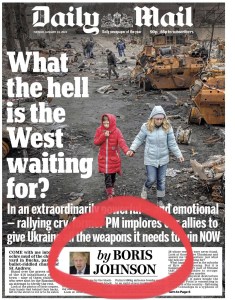
Odd footnote: After Boris Johnson flew off to Ukraine, his usual response when things get sticky at home, the Daily Mail published a front-page report under his by-line, as if he were a star reporter or something. Or perhaps an editor in the making, not that the dosh would be enough for him.

David Yelland, once the editor of the Sun, suggested on Twitter that Johnson had my old colleague Geordie Greig fired as editor of the Mail – presumably because he’d started reporting properly on his scandal-laden behaviour.

Another example of how those who run everything in this country are far too tangled up. In this case, two Eton old boys scrapping.

Incidentally, Greig has just been appointed editor of the online-only Independent.


j j j