Trump sues BBC over programme he never watches…

Panorama on Trump

Donald Trump vs the BBC is a thing now swollen like an appendix fit to burst. Let’s prod and see where we get.

The US president has threatened to sue the BBC for a billion dollars over an edition of Panorama. Wow, Trump watches Panorama! You’ll be telling me next that he hunkers down in front of Mastermind, shouting out answers through mouthfuls of cheeseburger.

Well, no – he doesn’t watch Panorama, even when it’s about him (his specialist subject). But he was alerted to a programme he never watches thanks to internal chaos at the BBC and pressure from the usual suspect newspapers.

The edition of Panorama in question was shown before last year’s US election and looked back at the insurrection of January 6, 2021.

It condensed into a clip a speech Trump made just before his supporters marched on the United States Capitol.

All the words used were undeniably spoken by Trump. You can find a transcript online. That was one long whiny ramble of a speech. It needed condensing more than anything that ever ended up in a can of soup.

Nothing Trump said makes you think, oh, he’s only trying to calm things down. The words ‘fight’ or’ march’ are not usually repeated so often when attempting conciliation (which, of course, he wasn’t).

Did Trump urge his supporters to march on the Capitol and protest about the election he lost? At such junctures it is traditional to say history will decide and nod your head sagely.

The trouble is, Trump has been busy rewriting history, removing official mentions of the Capitol riot, while also issuing pardons for around 1,000 of his supporters who were convicted of serious offences.

That edition of Panorama was only shown in this country – and, anyway, as Trump won the election shortly afterwards it can hardly be said to have damaged his reputation. He’s perfectly capable of doing that all by himself. Will he get anywhere with this Florida court case? Is he now going to sue all the world’s media? Or is it just part of his usual bully boy grift?

You won’t be surprised to hear that ejected Tory prime minister Boris Johnson is about to burst forth from that appendix. He set all this in motion when he reshaped the BBC in his image. As part of this, Robbie Gibb, Theresa May’s former communications chief, was appointed to the BBC’s board. This appears to have made the board in part anti-BBC.

Michael Prescott, a former Murdoch journalist and until recently an independent external adviser to the BBC’s editorial guidelines and standards committee, was the man who raised the contentious edit in a memo to the board.

He is said also to have made claims of systemic bias in coverage of Trump, Gaza and transgender rights, according to the Guardian.

All this led to the shock resignation of the director general, Tim Davie, and the head of news, Deborah Turness.

Johnson, typically, says talk of this being a right-wing instigated attack on the BBC is “complete bollocks”. So it’s almost certainly completely true.

A headline in the Telegraph urges Trump to sue the BBC

Are the Telegraph, Mail and others attacking the BBC because that’s just what they do? Or do they want to bring about its collapse to make room for more right-wing broadcasters, maybe funded from the US? That’s a lasting worry.

And this row about the BBC being left-wing comes just as many people are complaining about the BBC being too friendly to the right, especially to Reform UK and Nigel Farage.

To my eyes the BBC clearly favours Farage. I even put in an official complaint (result: nothing much). Farage receives endless unquestioning airtime on the BBC. Yet he would abolish it in an instant – along with the NHS.

Farage, who spends more time in the US than in his constituency of Claton, turned on his usual Trumpy toady act, complaining about the BBC’s attack on the “leader of the free world”. Good god, if he’s our leader we’re done for.

Honestly, I am more concerned about an elected British politician expending so much energy on doing down his own country. And to think he calls himself a patriot.

The BBC should defend itself and not bow down to Trump. Sir Keir Starmer should look at the running of the BBC – but he says he won’t be doing that. Perhaps it would just be better if politicians of all persuasions had no say in who runs the BBC.

Lord Patten, a politician who sees both sides, has been chairman both of the BBC and the Conservative Party. He had this to say…

“I don’t think that we should allow ourselves to be bullied into thinking that the BBC is only any good, if it reflects the prejudice of the last person who shouted at it.”

Quite so.

The BBC, for its faults and annoyances, for its occasional self-importance and inwardness, is too important, too central to British life, to be brought down by right-wing media owners considering only their own interests and pockets.

Just ask the 11 million people who watched the final of Celebrity Traitors.

j j j

This shouty need to have instant answers helps no-one…

On a train in Cambridgeshire at the weekend a man committed multiple stabbings. The reasons for this atrocity are as yet unknown, but news travels so fast now it instantly attains what you might call the speed of stupid.

Answers are demanded as those injured in an incident are still being blue-lighted away. This shouty need to know often comes from far-right agitators who hope what’s unfolding might align with their prejudices.

Nigel Farage of Reform UK plays this game too, while pretending to do nothing of the sort. I dislike quoting that man and only do so in the line of duty.

Here’s what he said on X before anything was known: “The attack last night in Huntington was horrific. My thoughts are with all the victims and their families. We need to know who committed these awful attacks as soon as possible.”

If you spotted a subtext hoping to blame an ‘illegal immigrant’, you will not have been alone.

British Transport Police later announced two men had been arrested: a 32-year-old black British national and a 35-year-old British national of Caribbean descent. The 35-year-old was later released and was said not to have been involved in the attack.

Spelling out the racial background of suspects is unusual but is intended to scotch right-wing conspiracy theories and social media misinformation, as spread so rapidly last summer after the murder of three schoolgirls in Southport.

The far-right may have been disappointed to discover that the man arrested was a British citizen, but they were still able to make vile mileage out of his race, as evidenced on social media. There is no satisfying these people and attempts to do so will always fail.

This willingness, nay eagerness, to believe what you want to believe and never mind the evidence is becoming a defining curse of the age. The US even elected as President a man who is consumed by a raging sociopathic compulsion to be right about everything and suppresses or denigrates anyone who offers evidence to the contrary.

There are other ways that such a shocking incident as that in Huntington can be used to bolster belief or prejudice. Many posting on social media later pointed with something like glee to another aspect of this sad story.

The hero of the hour was a rail worker gravely injured while saving passengers on the train. Samir Zitouni came to the UK 20 years or so ago from Algeria. He represents the best of modern multicultural Britain, although some on the right won’t like such elevation of an immigrant.

We should celebrate this man – but even to do that is to bend him to your side of the wider societal debate while he still lies in hospital.

Sometimes our eagerness to have the last word can override our humanity, our thoughtfulness.

Amid all this, the dormant scab of racism is being scratched into angry new life, thanks to Reform UK and others.

In the Guardian today, the Health Secretary Wes Streeting says he has been shocked by the rise in racism faced by some NHS staff.

Streeting said: “I’m disgusted that a level of racism last seen when Britain was a very different country, 50 years ago, has made an ugly comeback and I’m frankly shocked by those in parliament who’ve leaned into it.”

More such statements from Labour ministers would help.

LET’S end with an uplifting story about an Afghan refugee who found sanctuary here in Yorkshire.

Nahid Hamidi, above, and her husband Ahmad were targeted by the Taliban thanks to Ahmad’s work as a British Army interpreter. They fled the Taliban and Nahid has thanked the UK for giving her family a home.

Now living in Harrogate, Nahid has set up The Afghan kitchen, which has “fed thousands of people and offers other refugees help with their English – and a route into work”.

She said: “I am really happy. We want to say thank you so much to the government for this opportunity to come to the UK. I can work, my children can go to school. We feel safe here. But in Afghanistan, people are in a really bad situation.”

We are lucky to have Nahid in Yorkshire. This is the Britain we should celebrate.

I’ve gone off the BBC due to its unhealthy Nigel Farage obsession. But this is a good story. You can read it here:

Entrepreneurial refugee says ‘thank you UK’ for giving family sanctuary – BBC News

j j j

Never mind the TV adverts. We’re being dragged back to the 1970s by Farage and co…

I don’t know if Reform UK MP Sarah Pochin has been to Scarborough, but she won’t like what was written in the sand.

Pochin is the MP for Runcorn. What Runcorn did to deserve her is a mystery. Only it isn’t really. She squeezed in by six votes – a perfect illustration of why voting matters.

Anyway, Pochin swallowed the poisoned pint with enthusiasm. Inhaled the noxious nicotine. Or indulged in whatever it is that Nigel Farage gets his MPs hooked on. Mabe it’s vin rage bought by the caseload. One sniff or sip, and they are addicted.

Pochin, above, has proved to be a quick learner. On being elected by six people, she filmed herself for her YouTube channel saying that Greenway Road in her constituency was riddled with crime and social unrest because of illegal immigrants. BBC North West Tonight sent a reporter to interview locals on the street who said that wasn’t true and it was a lovely place to live.

Now she’s gone on Talk TV and said: “It drives me mad when I see adverts full of black people, full of Asian people.” It does what? It you lived through the 1970s, you might think you’d suffered a bang to the head and gone back there.

Responding to a viewer who complained about the demographics of advertising, Pochin said: “It doesn’t reflect our society”, adding, “your average white person, average white family is… not represented any more”.

Advertising is a notoriously hard-headed, nay cynical, industry that uses tricks and artifice to sell us things we probably don’t need. The notion that advertising bosses would fill adverts with black or Asian faces just to adhere to imagined woke guidelines is just madness. No, it’s whatever works for them or their clients.

And their choices reflect the changing face of society. That’s why they don’t sell washing powder by featuring a family of Ku Klux clan members (“It really washes whiter”).

Once nearly all the faces in adverts were white. And outside of the ads comedians were relaxed about making racist jokes.

We all thought we’d moved on. Until Farage started dragging us back a vile mile. In those days there were mass marches against the National Front. If you want a reference, think Reform UK but without the darkly donated US millions, the slavishly devoted BBC, or wall-to-wall social media.

What Farage does is make racism seem acceptable while pretending he is doing nothing of the sort. And he always has a hissy fit if anyone suggests he or his party is racist.

He held a press conference the other day, and the one before that. He can’t help himself. And the papers and the BBC trundle along, knowing there’ll be a lazy headline to hand.

In this press conference he said his MP’s remarks about adverts had been ‘ugly’ but not ‘deliberately’ racist. Oh, yeah. Pull the other one, it’s got a racist joke on it.

You can look up what Farage said if you wish. But the pattern is now long established. Farage is asked if someone in his party might be a teensy bit racist and he splutters, “How very dare you”, or something equally preposterous.

It was taken out of context, he’ll say. The context being that they said something that was racist. The thing is, Nigel, we saw or heard the racist thing. We know it was racist. And we see what you’re doing. You may pretend to decry the racist thing, but the racist thing was already in the headlines by then. Nasty job done.

Actually, I’ve no idea if Nigel Farage is a racist. But he certainly knows how to attract them. How to stir them up.

Let’s hand over now to the veteran Tory grandee Michael Heseltine, above. At 92, he is making a comeback, according to the Times. He has harsh words for Nigel Farage and Reform, whose policies remind him of Oswald Mosley and Enoch Powell.

Never thought I’d say this, but hurrah for Hezza.

As for Keir Starmer, he woke up enough to accuse Pochin of ‘shocking racism’ and to criticise Farage for showing ‘no leadership’.

Well, yes. But one disappointment with this Labour government is the way it has stuck to Tory or Reform UK rules of engagement over migration. Squint and you’d be hard pushed to tell the difference. With such a large majority behind him, Starmer could have framed the whole debate differently. Instead he just carried on putting all the blame on the four per cent of migrants who arrive here by small boats.

I spotted the Scarborough beach photograph on Threads. In a sorry sign of the times, the positive comments below the post were undermined by Reform UK knuckleheads being rude and offensive. As is often the way, they had few or no followers and had barely posted.

Then again, they might not even exist. The Eastleigh News reported that Reform UK’s Hamble Valley branch posted a page with the headline: “Real people – not career politicians”. This was apparently taken down after it appeared that some of those real people in the photograph had been created using artificial intelligence.

j j j

This notion of continual shallow distraction certainly resonates with me…

Image by Erik Lucatero from Pixabay


I was skimming an article when three words popped out of the grey text. They were “continuous partial attention”.

That pings a bell, I thought, pausing only to pick up my iPhone and scan social media, check my three email addresses and see if anything new had crawled out from beneath the news stone.

And I don’t even work any more, or hardly at all.

The article in the Guardian’s Saturday magazine was by Sophie McBain and had the headline, ‘Welcome to the golden age of stupidity.’ Technological advances are shrinking IQ scores, leading to brain rot, and “making it hard to work, remember, think and function”, apparently.

New technologies from the printed word onwards have always weathered such accusations, but is the advent of artificial intelligence only going to make matters worse?

A question to which the poached halves of my brain can only respond with an elongated ‘err’ followed by an ‘umm’.

I can’t yet claim to understand artificial intelligence, you see. We seem to be at the stage where everyone nods wisely and mutters ‘artificial intelligence’ without exactly knowing what it means or how it will affect our lives.

Even our government has been at it, suggesting that AI will make everything better and ‘grow the economy’, to call on those dullard words from the political lexicon.

Well, maybe, but has anyone bothered yet to read the terms and conditions, or is it just like always, where you tick the box at the end of a scree of words you don’t read, thinking oh, it’ll be all right.

But let’s settle for now with this notion that using artificial intelligence rather than our own intelligence might be damaging. To borrow the hackneyed phrase ‘use it or lose it’, it seems reasonable to suppose that asking AI to do everything for us won’t stretch our own brains much.

Thinking round a problem is an ancient skill, something humans are good at.

The tech consultant and academic Linda Stone term coined the term ‘continuous partial attention’ in the late 90s after noticing how her students “seemed to be trying to do 20 things at once”.

This notion of being continually but shallowly distracted resonates with me, not least because sometimes this blog is composed of bits and pieces found on social media (once Twitter as was, now mostly Threads), alongside snippets of news, stories clipped from newsprint, words half-heard on the radio.

That’ll make a piece, the distraction motor known as my brain pipes up, just as something else is spotted. Then the newspaper I was half-reading is dropped, or the TV programme I was half-watching no longer grabs my attention, later leading me ask, annoyingly, “What just happened there?”

There is always something in the blog snippet drawer, where potential items live, or mostly go to die. And look, oh, that actor we were wondering about, she was in that thing we liked, the one on BBC4, or Channel 4, or maybe ITV, possibly Netflix.

This digital splintering of our attention span, this need to glance away from what we are doing, risks leaving us unable to adsorb anything at all, doesn’t it?

Our smartphones are amazing slim tablets of everything. But they also give us the cheap hit of knowledge when all we’ve done is Google a question and received an instant answer. That’s miraculous in a sense, but the lack of effort involved is worrying, as too it out-sourcing our knowledge to US corporations.

Still, those of us old enough to know better can remember when life was different, grainier, less instant.

Today’s young people have no such experience, as has been shown in the new series of Channel 4’s Educating Yorkshire, above. The students are very attached to their smart phones; one sparky girl was even suspended and sent home rather than give up her phone for the school day.

For the teaching staff at Thornhill Community Academy in Dewsbury, first seen on TV 12 years ago, the most significant changes have been around mobiles and mental health.

Headteacher Matthew Burton is quoted below from a BBC website feature about the series:

“On the whole, there’s a lot more access to the internet and there are a lot more challenges around teenage mental health and anxiety. On the flip side of that, young people these days are much more attuned to their own mental health and how they’re feeling and are able to ask for the help they need, so we’re really proud of them.”

It’s a wonderful series, well worth a watch, mostly to be reminded of the wit, spirit and undying cussedness of teenagers.

As for this particular blog, it was composed almost without distraction or even one peek in the oddments drawer, leaving all those rancid leftover scraps about Trump and Farage untouched for now.


j j j

Now here’s a photograph to savour if nothing else…

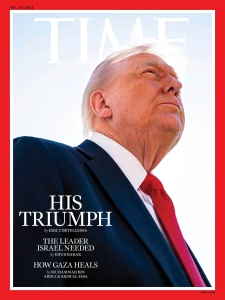
The Time cover Trump hates

I discovered the word kakistocracy and thought, wow, I’ll be using that as often as possible, then forgot all about it.

Meaning “government by the least suitable or competent citizens of a state”, it is drawn from the superlative of the Greek word for bad.

If you were to say that President Trump’s administration is deeply deserving of the label, I wouldn’t disagree.

But maybe we need another word or phrase to encompass a politician considered wildly unsuitable for the role he holds – and yet everyone he meets seems compelled to say what a sound and swell guy he is.

Perhaps psychotic sycophancy fits the bill, as the first word suggests losing some contact with reality – while the second suggests you are, to clatter downstairs to the linguistic basement, a terrible arse-licker.

Some still love Trump, while others, in the US and abroad, now gaze in abject puzzlement, wondering how such a morally dubious, imperious, misogynistic, vainglorious dunderhead could twice have become president.

A dunderhead, should that page have loosened in your dictionary, is an informal word for a stupid person; a splendid word, even if Trump is not that so much as a man totally unencumbered by knowledge.

A man who knows better than everyone else even though he knows nothing. Then again, perhaps a mock-monarch intent on grabbing all the power there is, while seemingly amassing as much wealth as possible for himself and his family, is less of a dunderhead than those who voted for him.

As we know to the vanishing point of boredom, Trump’s every graceless speech is embossed with cheap studs of boastfulness and wrapped in gold ribbons of self-regard.

Mind you, he’s had a good week, having brought eternal peace to the world, or something. It would require a deeper brain mine to examine in detail the agreement between Israel and Hamas to end the fighting in Gaza and release hostages. Is it a peace deal, another ceasefire or a shifty smudge somewhere between?

Even a shallow-brained observer might peer through the reality-TV-style braggadocio and fear everything could fall apart if the pressure isn’t maintained. Trump is interested in bragging rights rather than details, so it could happen. And he bores easily, much as the rest of us do when forced to listen to him.

One detail mentioned by many observers is that Trump’s deal is essentially the same as one agreed ten months ago by President Biden – but Trump wanted that deal delayed until he was president. As did Benjamin Netanyahu of Israel.

Follow this argument to its grisly conclusion and you see leaders who were apparently prepared to keep the deaths mounting in Gaza for their own political ends. Again, deeper brains than mine will determine the truth of that allegation; but how shocking if true.

Psychotic sycophancy, by the way, seems to be a quality Trump values in those he employs. Steven Cheung, the White House’s director of communications, wrote that Trump would “continue making peace deals, ending wars and saving lives”. Adding, as if that weren’t plenty already, “He has the heart of a humanitarian, and there will never be anyone like him who can move mountains with the sheer force of his will.”

You might quibble that many politicians from many countries worked on that deal, while Trump slapped his name on it. But those of us who detest the man can at least concede that he got this deal, if that’s what it is, over the line.

Still, all that bullying talk, pleading and shameless lobbying to be given the Nobel Peace Prize was and remains demeaning and pathetic. Asking for something so often and so loudly should trigger an immediate disqualification.

Death and misery all round, and Trump seemed most concerned about whether or not he won a ‘gold star’ from Norway. In the event the prize went to Venezuelan opposition leader María Corina (who promptly announced that Trump ‘deserved it more’, for heaven’s sake).

There has been some uplift for the anti-Trumpers in that photograph just used by Time magazine for its cover. The story inside is a glowing report, but Trump still wasn’t happy. The vain old fool just hates the photograph, calling it “may be the Worst of All Time”.

Taken with the sun behind his head, the photograph peers up from below, putting emphasis on his crumpled concertina neck, and peeping beneath his carefully arranged coiffure to suggest the bald head within. A sly way to poke fun at Trump while celebrating him.

Oh, and incidentally, the ear hit by an assassin’s bullet appears to be in splendid nick, should you be wondering.


j j j

Ignore the right-whingers and you’ll have a lovely time in London…

Leadenhall Market

JUST back from a weekend in London, that infamous hellhole. I took a spare Rolex in case one was stolen. That’s a joke, naturally, as I am more likely to wrap a cobra round my wrist than a Rolex.

It has to be said that the lawless ruined city of Nigel Farage’s stove-top imagination, that seething place of rampant wokeness and people cowering indoors for fear of being robbed, or perhaps for fear of bumping into Mr Farage out with a GBN microphone and a phalanx of bodyguards, was looking on top form.

Fearlessly did we walk the streets of Southwark on the Friday afternoon to the Old Operating Theatre and Herb Garret.

On the way there we stumbled on Crossbones Graveyard and Memorial Gardens. This post-medieval graveyard stands in memory to the 15,000 paupers thought to be buried there. A magically chaotic place, part garden, part artwork, almost at the gleaming foot of the Shard.

The woman on the door directed us over the road to Red Cross Garden, designed by the Victorian social reformer Octavia Hill, one of three founders of the National Trust, another good discovery.

The Old Operating Theatre offers a fascinating delve into surgical history and is only occasionally gruesome. It’s housed in the attic of the early eighteenth-century church of the Old St Thomas’ Hospital, and the operating theatre itself stands as a medical chapel.

The second part of the museum’s name refers to the drying of herbs, although you have to admit that Herb Garret would be a cool name for a jazz musician.

On Saturday morning we went early to Borough Market before the arrival of the lawless mobs (otherwise known as people from all over the world having a good time).

After that we crossed the river to the City, visiting St Dunstan in the East, above. The church, built around 1100, was severely damaged in 1666 by the Great Fire of London, then bombed in the Blitz of 1941. The ruins now form an enchanting place of peace and greenery, with shining towers all around.

After that it was on to Leadenhall Market a grand covered market, where we had a grand cup of coffee.

The City looked amazing in the sunshine, and this visit upturned my preconceptions. I’d always believed there are now too many sky-scrapers, those glittering monuments to the inequities of capitalism (or something else equally woke). Well, perhaps. But here’s the thing – these giddying, glass-spun structures look amazing next to old London, and they befit a capital city; don’t they?

A walk over Millennium Bridge, above, another great architectural achievement, took us briefly to Tate Modern, before going to see Twelfth Night at the Globe theatre. The tickets were a birthday present for me from our three grown-up children, and the production was properly funny and delightful.

We spent our last day getting lost on the way to Kew Gardens, thanks to incompetence, and also to Waterloo station shutting the moment we stepped through its portals.

But we got there in the end. Kew was wonderful. The tree-top walk is a great addition since my only previous visit somewhere down a crevice in time.

I was a student in London, lived there for ten years or so, and love to return to this city of many cultures and people.

Although the usual suspects bellow that the capital is becoming more dangerous, the crime figures indicate otherwise. Listen instead to the senior police commander Andrew Featherstone, who said to the Guardian the other day that there was “no doubt” it suited “some people, organisations and others” to suggest London was crime ridden.

“When you look at the actual facts, that is not true,” said Featherstone.

Ah, yes – actual facts. You know, things that are known or proved to be true. As we know, politicians of the right constantly deny facts and twist the truth into any shape that suits their purposes (a certain US president even fabricates lies in order to send troops into cities he disfavours).

London has its problems, where doesn’t, but the right-whingers hate London because it’s a multicultural city that works – and as such stands as a riposte to everything their mean souls hold dear.

We’ll be back. My only gripe, incidentally, concerns the shortage of decent pubs around Blackfriars. A beer desert but never mind.

Yes, exactly that…


j j j

That was 50 years ago? You must be kidding…

Goldsmiths College, as it was then called

Goldsmiths College, as it then was

SOME anniversaries bring you up short. That can’t be right, you think. Looking back to 1975 is like that for me.

Once on a distant day a car drove from Cheadle Hulme to Lewisham in South East London. That car contained a young man about to turn 19, his parents and, if flickering memory holds true, one grandmother.

My luggage included a classical guitar, new pots and pans, and a small stainless steel teapot bought for me by the accompanying grandmother; that teapot always did spill but was treasured for years. More treasured was the guitar. The neck broke a long time later in a house in York I never knew I’d live in, with a woman I’d yet to meet, alongside three children who were but specks on the horizon.

As to the delights of having a granddaughter, oh, look I’m an insecure young man who walks around with the Times Literary Supplement sticking out of his pocket, on full show, so don’t expect me to think that far ahead. I have important posing duties to perform, beer to drink, friends to make, my virginity to lose.

The car went up the road to turn round, and by the time my family returned to say goodbye I’d hurried inside to see what this new life held. A lapse my mother was to mention more than once. Some lessons take a while to learn. Many years later, having dropped our eldest off at university, my wife and I drove to a grotty service station where we snivelled over cups of bad coffee, before continuing our journey home.

Yes, by some quirk of time, by a tear in the space-time continuum, it is 50 years since I went to university. In those days you couldn’t look up space-time continuum on Google to check its meaning. It was before computers, long before smart phones too, and a coin-box phone with a queue was your only link to home.

Again using what is available now but wasn’t then, I can see that Margaret Thatcher was elected leader of the Conservative Party in 1975; the Vietnam War ended; the first oil was pumped from the North Sea. Fawlty Towers and The Good Life were on the BBC. And…

Oh, you know, this doesn’t really help. Better perhaps to summon up the past as it seems from this distance. I did not keep a diary, so there is no record of the daily scratch and tick, just the swirls.

I’d rarely been to London before going there as a student. There was a school trip when we were advised not to stand too close to cars in case they blew up (true story, or so my memory insists).

For three years I studied English Literature at Goldsmiths College in New Cross, an institution now known as Goldsmiths, University of London. It’s fair to say those years shaped me or misshaped me or something. My newspaper life included ten years on the South East London Mercury, long since deceased, just round the corner from Goldsmiths.

A lifelong love of reading was cemented at that time, and I ended up working with words, wrote a few novels, and have never stopped pushing one word up against another to see what sound or shape is made.

Music was important then, a signifier, something to hide behind or argue about. Google tells me that Peter Gabriel left Genesis in 1975. In that student hall I used to be rude about Genesis, never having been a fan unlike so many others there. This was perhaps a bit of a nerve from a lover of the Grateful Dead, but in mitigation I would plead Elvis Costello, Joan Armatrading, Van Morrison, Ry Cooder and others.

Danny Thompson

Danny Thompson

Solid Air by John Martyn remains my favourite album, released two years earlier. By a quirk of timing, the brilliant double bass player Danny Thompson, who features on the album, has just died, aged 86.

According to his obit in the Guardian, Thompson, who was a member of the folk band Pentangle, formed with Martyn what the writer Mark Cooper called “a notorious double act as they slurred their way between sentimental tenderness and barely camouflaged rage”.

The hall where we lived, watched occasional episodes of Doctor Who, and listened to Henry play the piano was formed from three or four terraced houses. It’s not there now, although a small unfurnished one-bedroom flat in that road can be had for £1,650 a month, according to a local estate agent.

We used to trek up the hill to the heath, walk to Greenwich and a favourite pub. Or go past Greenwich Theatre, where I ended up reviewing plays in my Mercury days.

Many friends were made at that hall and at the university. Mostly they drifted to wherever it was we all ended up. Some died too young, including my great pal John. I speak to one cherished friend every Christmas, another lives in the US but we met in a pub in York a while back, another is in contact occasionally on Facebook.

It is a cliché of the interviewer’s art to ask someone what they would tell their younger self. Kirsty Young has even spun a BBC radio series from that query.

If I play that trick on myself, I’d answer – oh, don’t worry there are plenty of other people to be critics on the Guardian or to write the television column in the Observer. Others will write those great novels. You’ll still fill most days with what you want to do. You will fail sometimes and succeed at others; you will be great, you will be OK, you will be mediocre, you will be who you are and not who you thought you wanted to be. You’ll be a husband, father, grandfather.

Yes, you – you with the Jimi Hendrix hair and a copy of the TLS sticking out of your jacket pocket for everyone to see.

It is strange how clearly you remember what happened 50 years ago, unless, of course, I have the details wrong. Perhaps someone from the dim distance will point out any errors.


j j j

A few thoughts on Musk, Charlie Kirk and why I finally quit X…

King Charles while listening to Donald Trump

I have finally deactivated my X account. This was the day after Elon Musk attempted to deactivate our democracy. Musk’s sin was greater than mine but having an X account still felt unclean.

I should have gone long ago. The app was removed from my iPhone a while back but left on my laptop where it languished mostly unseen, aside from guilty peeks.

Twitter was quite good when I joined. Then Musk bought it, changed the name and started using his immense wealth to further far-right causes, stirring up hatred and rancour.

Last weekend, Musk beamed into Tommy Robinson’s far right march in London (and, yes, it was far right – calling it anything else is to normalise hatred).

Appearing on screen rather than in person, Musk called for a “dissolution of parliament” and a “change of government”. He said other inflammatory things I do not wish to repeat, ending with: “Whether you choose violence or not, violence is coming to you. You either fight back or you die, that’s the truth, I think.”

Whatever you think of Sir Keir Starmer, the tech billionaire should pipe down. It’s just not his concern.

Why should we have to put up with Musk, an awful man of fathomless wealth and scant scruple? The tech billionaire briefly went on a blind date with Nigel Farage, only to declare him not extreme enough. He turned his affections towards Robinson, a convicted criminal who is really called Stephen Christopher Yaxley-Lennon.

The only benefit in all this lay in seeing the hubristic smirk wiped off Farage’s face.

Our politics seem to be becoming increasingly American these days, partisan, shouty and belligerent. I used to be such a fan of American cultural imports, of the literature (Saul Bellow was a great favourite, F Scott Fitzgerald too), the TV shows (The Wire, The Sopranos, Six Feet Under, ER), and the films (anything good by the Coen Brothers…). But I could do without the politics.

Musk is behind attempts to turn conservative activist Charlie Kirk into a Christian nationalist martyr, urging his millions of followers to “fight or die” (his script is consistent, if nothing else).

Like many Brits, I knew nothing about Kirk until he was shot. After his assassination I discovered all sorts of stuff I wish I’d never known. His views were vile, racist, homophobic, gun crazy and designed to stir up hatred among the young.

President Trump, who considered Kirk a key ally, immediately blamed the ‘radical left’ for the shooting, despite having zero evidence. Yet another reminder that US presidents once at least attempted to bring the country together: now it’s hate first and think later, or not at all.

In the US right now it is almost a crime to say anything critical about Kirk, or just to appear insufficiently mournful about his death. Even quoting from the horrid list of things he used to say is treasonous and an invitation to be sacked.

Just ask former Washington Post columnist Karen Attiah, who says she was let go for, as she put it, “speaking out against political violence, racial double standards, and America’s apathy toward guns”.

Now I encounter a difficulty at this point. I have never read anything by Attiah and know little about her. Much as I have rarely watched the US TV host and comedian Jimmy Kimmell, who has just been suspended from his late-night show for criticising Trump.

Someone who does know about all this is President Obama, as quoted here:

“After years of complaining about cancel culture, the current administration has taken it to a new and dangerous level by routinely threatening regulatory action against media companies unless they muzzle or fire reporters and commentators it doesn’t like. This is precisely the kind of government coercion that the First Amendment was designed to prevent – and media companies need to start standing up rather than capitulating to it.”

And what Totalitarian Trumpington doing while all this was going on? He was being feted by our royal family and prime minister on a state visit, that’s what. A curious occasion and quite low-key for such glistered gladhanding, with the Trumps kept away from political settings, London and from any likelihood of protest.

Mind you, the Led By Donkey guys did manage to project images of Trump alongside Jeffrey Epstein on to Windsor Castle on Tuesday. For which stunt they were arrested. “Orwellian” and “ridiculous”, said the group, and they’re not wrong.

I cannot see why this visit went ahead, what we gained from giving the spare room to such a troublesome guest, and why we had to endure the usual stale Trumpian lectures, as parroted in this Daily Mail headline.

Still it was a minor treat to witness King Charles frowning and trying not to giggle as Trump read this encomium from his speech: “He’s given his whole heart and everything he’s got to the parts of Britain that are beyond the realm of mere legislation.”

The King looked as puzzled as the rest of us.

Trump, being Trump, couldn’t resist the usual childish prattle, saying: “We had a very sick country one year ago and today, I believe we’re the hottest country anywhere in the world, in fact nobody is even questioning that.”

That’ll be down to that global warming you insist doesn’t exist.

Here, to end, is a cartoon by Jack Ohman as borrowed from Daily Kos on Threads.

j j j

The BBC gets back about my complaint… sad to see Rayner go… some caffeinated claptrap about coffee…

As mentioned here last time, I complained to the BBC about “the endless slavish and unquestioning coverage” given to Nigel Farage and Reform UK.

Now the BBC has got back to me. Or, rather, to myself and every other similarly displeased person. To us all has been sent a dollop of corporate dung-speak from which there rises an unpleasant smell. I have attached the reply to the end of my last blog.

Short version (with a slick of added cynicism): we are right, you are wrong, and while we’re happy to hear what you have to stay, you’re still wrong and we all love Nigel round here.

Two points the BBC makes seem worth raising here.

First point. The BBC says the coverage is right because Reform UK has been “making the political weather”.

Well, it’s making the political weather because you keep puffing a gale up its sorry arse. Many elements contribute to the political weather, but the BBC endlessly banging on about one party above all others must be the biggest factor.

Also, ‘political weather’ is just lazy shorthand for Nigel Farage making a lot of noise and the BBC reporting every belligerent bellow, usually without accompanying analysis into the aforementioned noise.

Second point: “We give careful consideration to ensuring any story concerning Mr Farage and Reform UK are given proportionate and appropriate coverage on our networks and online.”

And yet other parties hardly get a look in. Oh, apart from the Labour government, which frequently is given a kicking by the weaselly Chris Mason, political editor (apparently).

The BBC has traditionally been considered left-wing by those on the right, and right-wing by those on the left. Sadly, as the corporation now appears to be run by right-wingers that argument has surely been settled.

But whatever view you take, it would be healthier if politicians of all persuasions had no influence on the BBC. For self-serving reasons, Boris Johnson felt the BBC was too left-wing, so he ‘fixed’ that – in part creating the one-sided BBC we now have.

As most media in this country is right-wing, the BBC should be neutral to balance the scales, rather than acting like a second cousin to the Daily Telegraph.

Incidentally, the BBC seemed less keen on reporting how Nigel Farage was taken down a peg or two in the US where he’d gone to plead for help with “the really awful authoritarian situation the UK has sunk into” on free speech. For his troubles he was called a ‘Putin-loving free speech impostor’ during a congressional hearing.

Breaking off for a moment to bang my head on the nearest brick wall (ouch!), that’ll be the US as run by a dictatorial president (“Maybe people like dictators”) who wants to control the universities, the media, the museums, history, the arts, who sends troops into Democrat-run cities to ‘solve’ crime problems that don’t exist, who has masked thugs arresting people on the street, and bundling them away.

Yeah, sure, but we’re the ones with an “authoritarian situation”.

Farage took time off from Parliament to badmouth Britain in this way. He’s the strangest patriot you ever did meet, but then his only true loyalty is to himself.

Oh, and this country is so authoritarian that an opposition politician can be paid a fortune to appear on a TV station where he is free to spout whatever rubbish he likes (with a favourable tax arrangement, too, reportedly).

Ouch! I’ve just banged my head again.


I WAS sorry to see the resignation of Angela Rayner, mainly because, whether you like her or not, she is an authentic Labour politician with a true story to tell.

The Guardian editorial on her departure contains the curious observation that: “If a minister takes the hit early and with contrition, they may be able to rebuild their career once public anger cools”.

Well, maybe – but the embers of that ‘public anger’ were mostly blown on by the Daily Telegraph, which incidentally now calls Nigel Farage “Britain’s next prime minister” at every mention.

Sadly, the posh boy element of the media hate what Rayner represents as a working-class woman who rose from a tough background in Stockport to become deputy prime minister. She had been held to standards that never attached to Tory ministers of recent times, as shown in this reminder here.

Image taken from Threads/Instagram

But I don’t understand why she didn’t seek official advice on whether she needed to pay more stamp duty. Worth adding, though, that her personal situation is quite complicated thanks to a previous family home being made into a trust for her disabled son. And that flat she bought in Hove is said to be the only property she owns.


IT MUST be time for a coffee after all that. Although not from Costa, as buckets of vaguely coffee-tainted milkshake are not to my taste. Something stronger, please.

According to a report in the Observer last weekend, Costa Coffee is underperforming against the artisan coffee shops popping up all over the place.

I always favour local coffee shops over the big brands, especially as in York there are so many good ones to choose from.

Anyway, Costa is owned by Coca-Cola, which shelled out £3.9bn for the dubious privilege in 2018. According to that Observer story, the company’s chief executive reportedly told analysts that Costa “had not quite delivered” and was “not where we wanted it to be from an investment hypothesis point of view”.

I have read that statement more than once and can find no possible meaning, even after an extra coffee.

Incidentally, should you spurn Costa in favour of Starbucks, it’s worth knowing that CEO Brian Niccol made “6,666 times more than the company’s median employee in 2024”. The figure is as quoted by Professor Robert Reich at Berkeley.

That’s Starbucks crossed off the list, too.


j j j

Nigel’s making plans for Nigel…

How the Telegraph reported Farage’s Taliban idea…

What unlikely connection exists between the Taliban and the journalists of Nottinghamshire Live? Well, Reform UK suggested doing a deal with the former but won’t talk to the latter.

To set this in context, Nigel Farage flourished his latest mass deportation plan at a press conference in Oxford on Tuesday, pledging to send back “absolutely everyone” arriving in the UK on small boats, including women and children. By yesterday he’d already stepped back from that after being accused of ugly and destructive rhetoric (to be fair, the only sort he knows).

Paying the Taliban to accept migrants was one of his suggestions – a gruesome scheme that could have seen people who’d fled the Taliban being returned to Afghanistan to face extreme danger, or worse. And the British taxpayer would have to pay the Taliban. Unsurprisingly, the Taliban said they could work with this, while everyone just else put their head in their hands.

When a reporter at the first conference asked Farage if he was bothered about women and children being sent back to Afghanistan, the spluttering little man said he was more concerned about the social unrest on our streets, and the safety of women at the hands of migrants.

Ah, yes – the social unrest Farage has exaggerated wildly and also conjured up with his endless divisiveness, his confected, opportunistic outrage. His – oh, God, his horrible bloody everything. The hatred, the grievance, the sucking up to Trump; yes, the lot, every squalid shred.

And he’d like to deport your rights, too.

Farage wishes to abolish the European Convention of Human Rights (ECHR), brushing aside assorted securities so that if elected (heaven forbid) he could do whatever he wished without legal restraint.

Oh, and he and his American billionaire petrol-powered chums and right-wing backers would also then, according to entirely believable concerns, like to abolish the state pension and the minimum wage, along with paid holiday and sick leave, start fracking everywhere, loosen our gun laws, and eviscerate what’s left of the NHS, leaving us with an unaffordable US-style insurance system instead.

Oh, you lot are always saying mean things like that about our Nigel, the Reform UK followers will complain, while struggling to squeeze into their new Reform UK football tops (honestly, I’ve not made that last bit up) before shinning up a lamppost with a St George’s flag.

Well, yes, we are – and so we should.

Farage needs to be exposed to full scrutiny, rather than the easy ride he so often receives, where the screens and the pages are emptied so that he can spew out his latest racist bilge. He has never run anything aside from assorted political parties made in his own image; and he has never worked in government; mostly just on making himself very rich.

One retort for Labour would be to remind everyone about Brexit, that cause of so many of the country’s ills – including the so-called small boat crisis, brought about in large part by Brexit, as owned by Mr N Farage.

Slogans aren’t everything, but a cutting one would help, something distilled from: ‘Don’t buy anything from this man – remember what happened last time he knocked on your door.’

I only hope Farage has peaked too soon. And just wish the media would say, oh, do pipe down Nigel and come back in four years when there’s actually an election.

Apologies to those journalists from Nottingham, who’ve been left hanging around since the first paragraph. What’s happened is that Reform UK’s councillors in the area are refusing to speak to the local media and will not invite the journalists to cover county council events.

Reform UK, locally and nationally, do hate being held to account. As the website writes: “Nottinghamshire Live and its historic Nottingham Post newspaper, which has been delivering news to the city and county since 1878, has essentially been told it is no longer allowed to scrutinise those running one of the biggest authorities in our area.”

Of course, if you’re weary of seeing Farage everywhere, I suggest a visit his constituency in Clacton on Sea. He’s never to be found there.


Although an admirer of the BBC, I have made my first complaint to the corporation. You will not be surprised to learn it’s about Nigel Farage, whose every squeak is amplified by the BBC into an uncritical chorus.

Here is the wording of my complaint, under the heading: Endless pushing of Nigel Farage:

“As a longtime fan of the BBC I am mortified by the endless slavish and unquestioning coverage you give to Nigel Farage. His every utterance is promoted, including his remarks today about a ‘scourge’ of immigration. You appear to be pushing Reform UK without offering balancing views. Not good enough.”

Stronger words are available, but those were mine.


Footnote:

Since this blog post was published, the BBC has replied as below:


Dear Audience Member
Thank you for getting in touch with us about our recent news coverage of Reform UK.

BBC News is committed to providing our audiences with fair and impartial coverage of all relevant political parties. Whenever we invite representatives of any political party to take part in our coverage, we are careful to ensure that views are appropriately challenged and analysed, over an appropriate period of time. Our Editorial Guidelines make it clear that: “Evidence of past electoral support and current electoral support should be taken into account in making judgements about appropriate levels of coverage and prominence.”

Traditional voting patterns across Britain have been shifting, providing a challenge to established political parties, especially Labour and the Conservatives. At the 2017 general election, those two parties combined won more than 80% of the vote – at last year’s general election, that figure was well below 60%. Current opinion polls put their combined support at nearer 40% across Great Britain.

During the last year or so, Reform UK (formerly the Brexit Party) appear to have been the main beneficiary of this shift. Our assessments of “past electoral support” include both representation (ie how many MPs are elected) and also vote-share (ie how many people actually vote for a party overall). Although they have four MPs currently, Reform UK won more than four million votes in the 2024 general election, making them the third largest party in terms of vote share (more than 14%), behind Labour and the Conservatives, but ahead of the Liberal Democrats, who nevertheless returned more than 70 MPs.

In the 2025 English local elections in May, Reform UK won a majority of ten councils plus two Mayoral contests, securing more votes across England than any other party (an estimated national share of above 30%). On the same day, Reform UK won a parliamentary by-election in Runcorn and Helsby, with nearly 39% of the vote in that constituency.

Assessing “current electoral support” includes an obligation to take into account legitimate opinion polls, especially where there are robust and consistent trends (as measured by voting intention polls conducted by members of the British Polling Council). All such surveys fully conducted since the May elections (a total of more than 90 consecutive polls) indicate that Reform UK are ahead of all other parties across Britain; during August, the party’s polling average across 17 opinion polls, from a range of companies, increased to 30%, ahead of Labour (21%), the Conservatives (18%), the Liberal Democrats (14%) and the Green Party (9%).

Recently, Reform UK announced its immigration strategy and we considered many people who had voted for the party (or say they intend voting for it) would be interested in seeing the proposals. However, BBC News hasn’t simply reported on the strategy, we have also provided political analysis, scrutinised its spokespeople and heard from many individuals and parties across the political spectrum, including the government, providing a wide range of views on the issue.

With regards to Nigel Farage, he is an elected MP and leader of a political party with clear evidence of significant electoral support. Many political analysts across the media, with different political perspectives, report that Reform UK are “making the political weather” – in other words, the reactions and policies of the other political parties can only be properly understood in the context of knowing what is happening with Reform UK and its increased level of support.

We give careful consideration to ensuring any story concerning Mr Farage and Reform UK are given proportionate and appropriate coverage on our networks and online. We thank you for taking the time to get in touch, and your comments have been passed along to senior news editors.


j j j