Stepping around a ‘fiscal black hole’ that isn’t really there… and don’t mention the B-word…

This ‘fiscal black hole’ we are hearing a lot about reminds me of those clever pavement artists who draw something that isn’t really there at all.

The sight of this deep hole is enough to induce vertigo, although it would be perfectly possible to walk right over.

What a pair of political pavement artists. The chancellor with the name that’s often tripped over to pleasing effect, and the extremely wealth prime minister who still can’t buy trousers that reach all the way to his little feet.

This black hole they’ve drawn is a perfect excuse for a round of cuts and a return to what even the CBI has warned will be the “economic doom loop of austerity” – scary, sounds like the title of a progressive rock album you never want to hear again.

The Progressive Economy Forum argues that the reported £50 billion “hole” the chancellor and prime minister have drawn is “the result of government accountancy rules and highly uncertain forecasts, not tax or spending decisions”.

In other words, it suits them.

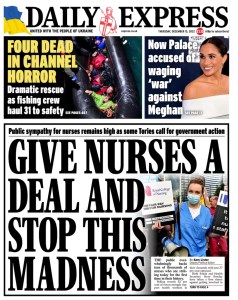
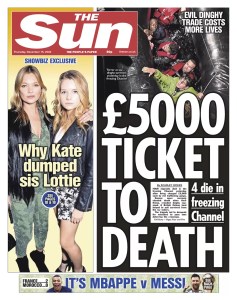
There is a lot of this going on. Talking up the so-called migrant crisis is a convenient distraction that makes the ‘problem’ much worse than it really is, helped along by an obsessive media interest in desperate people who risk their lives crossing the Channel in small boats.

While the man in the short trousers is wringing his hands about that, he diverts attention from what a giant, stinking mess his government is making of everything.

The economy shot to pieces, trains not running, inflation soaring, energy prices through the uninsulated roof, hordes of workers going or threatening to go on strike (quite understandable, as their pay has effectively been diminishing for years).

Don’t worry about all that – just look at those people invading our shores.

Rishi Sunak says our economic downturn is “the legacy of Covid” and “what Putin is doing”. That’s still pushing blame elsewhere while inflicting yet more austerity on already-shredded public services. Oh, and don’t forget the tax rises.

Also, here’s something missing from his list. Something those pavement artist tricksters have rubbed out altogether.

Yes, the B-word. The former Bank of England official Michael Saunders said the other day that Brexit has “permanently damaged” the UK economy, while also calling for closer trade links with EU.

Obvious stuff, really.

Hardly anyone in government will admit that Brexit was clearly a terrible idea, as it’s a matter of weird fundamentalism for too many of them. Either, they’re like Jacob Rees-Mogg forever lying through his over-entitled teeth about how great it’s all going. Or they are looking the other way and humming, as David Cameron did when he resigned after losing that referendum.

And don’t go asking Labour leader Sir Keir Starmer to say anything sensible about Brexit. He just says things like “we’ll do Brexit better/properly…” Er, how does that work, then? A terrible idea is a terrible idea however you approach it.

This is all so disappointing. Surely Starmer could just admit Brexit has been a catastrophe brought about by the never-ending psychodrama of the Tories versus Europe (not all Tories, but it’s mostly been their squabble).

Sadly, pathetically really, Starmer is too afraid about putting off pro-Brexit voters who may vote Labour next time. Oh, they may have seen the light by then (that’s if the power’s not been cut). They may even have died, still dream of those sun-lit uplands.

Whatever, the next fight is never the same as the last one.

As for that fiscal black hole, it might not really be there. But right now, it looks like we’re all going to be dragged into it anyway.

j j j

All praise to Squeeze for the music and for railing against food poverty…

Chris Difford and Glenn Tilbrook

You have to love a bit of Squeeze.

And now there is an extra reason to feel affection for Glenn Tilbrook and Chris Difford, besides the punch-drunk, teary joy of all those evergreen short-story songs about ordinary lives.

On tour at the moment, the onetime south-east London lads, now comfortably into their sixties, can still belt out the old hits and more in lively style, as they showed last week at the Harrogate Conference Centre.

It’s still cool for old cats, as this old cat would concur in hope.

Tilbrook leads the show, singing and playing guitar. He is an overlooked guitarist, who plays quite brilliantly at times, running off into blistering solos that never last too long.

There are seven in the band now, and it’s a confident, ringing sound, and by the end everyone is on their feet, quite something for a Harrogate audience, some of whom need help getting up.

You have to love a bit of Squeeze.

You see, this tour and an accompanying EP and single, Food For Thought, are raising funds for food banks and awareness about food poverty. Donations are being collected at gigs for the anti-poverty charity the Trussell Trust, which operates food banks across the country.

In a news report for the Guardian (print edition, November 5), Tilbrook says that for years he was unaware of many things, being in his own “bubble of success”. Now he rails against the poverty crisis.

“It’s terrible and wrong that so many people have no choice other than the help that food banks provide to feed their family,” he says. “That there are so many people who have to choose between heating and eating is a disgrace.”

Tilbrook adds that the social security system was “set up to save people who didn’t have work, and now people are earning wages and it’s still not enough”.

As nurses vote to strike, worn out by seeing their pay diminish year after year, and as some nurses are forced to use food banks set up in the hospitals where they work, this Squeeze tour could not be timelier.

The Trussell trusts sent out 1.3 million emergency food parcels in the past six months –  just one provider of a service that shouldn’t be needed in a properly functioning country.

Various Tory MPs like to bluster about food banks, saying it’s just that poor people don’t know how to cook or budget properly. Invariably porridge is mentioned. Google for more details, but my fingers will not type their names.

You have to love a bit of Squeeze.

Back in the 1980s, as surely mentioned here before, I interviewed Glenn and Chris for the South East London Mercury a few times.

That Guardian report mentions “Jools Holland appearing on keyboards at one point”, which seems dismissive. He was there for quite a while, before wanting to go his own way. “Jools has got his own things he wants to do,” as Tilbrook told me.

Jools, who is quite grand nowadays, lived then in a basement flat and kept his gold records on the loo wall. Or he does in my memory, as it was a long time ago, and time plays tricks, the lens can smudge.

I still have an affection for Jools though, not so much the albums, of which I own a few, as the roof-lifting live concerts. And I must have watched most editions of Later, which has been going for 30 years now.

You have to love a bit of Squeeze.

When Jools left he did a final gig at the old Albany Empire in Deptford. Elvis Costello, who produced their album East Side Story, turned up as a surprise guest.

It was quite the night.


A lottery player in California has just won $2 billion on one ticket. As a long-time Lottery loser, that news stirs mixed emotions.

Yes, money would be good, but not that much. Such an unfathomable fortune in one go would be a golden curse.

Sometimes I do say a little prayer to the lottery god, while having another go at Lotto or Set For What’s Left Of My Life, but he just replies: “Here’s £30 to keep you going, now shut up.”

More than thirty quid would nice, but I am happy to have so far avoided two billion.


j j j

Why Suella Braverman stirs memories of the National Front… and what my old editor would have said…

The Battle of Lewisham in 1977 (Picture: BBC)

What my old editor Roger Norman would have thought about the home secretary referring to asylum seekers as an ‘invasion’ cannot be known, as he died in 2006. But he would not have been impressed, for sure.

The reason for raising this is not only the smudged nostalgia of a man regarding the start of his career from somewhere near its end. It is because Roger stood against the National Front while he was editor of the South East London and Kentish Mercury.

He would surely be horrified to know the right-wing racism he confronted in the 1970s finds an echo today in the language used by Suella Braverman.

As my old colleagues Peter Cordwell and Pat Greenwood noted in an obituary for the Guardian, the 1970s and 1980s were crucial decades for the Afro-Caribbean community in Lewisham.

“When the National Front wanted to march through his patch of New Cross in 1974, Roger’s front page lead spelling out in words and pictures exactly what they stood for was headlined ‘You’d Better Believe Us!’.”

He also, they wrote, numbered among community champions who by “tirelessly giving a sensible steer towards harmony, helped create the ‘live-and-let-live’ ethos among south-east Londoners that set the scene for today’s multicultural society”.

That is certainly true, although from this distance it seems as if that multi-cultural society is both a good and undeniable part of our lives – and something to be given a kicking by right-wing nasties.

There is not a direct comparison between the white-power National Front marching against the local Afro-Caribbean community in the 1970s and Ms Braverman’s deeply hostile portrayal today of the ‘migrant crisis’ (that’s if such a crisis even exists).

But what seems horribly telling is that the sort of vile language once found in the rank silos of the right now flows into our lives – much as all that shit flows into the sea.

Ms Braverman seems only to have increased the difficulties faced by asylum seekers living in the overcrowded Manston migrant processing centre in Kent.

The senior Tory backbencher Sir Roger Gale told Sky News that the overcrowded facility, where outbreaks of MRSA and diphtheria have been reported, were “wholly unacceptable”, adding: “These circumstances, I believe now were a problem made in the Home Office.”

The Times reported yesterday that senior Conservative MPs feel the home secretary risks fuelling support for far-right extremists, with one unnamed former Home Office minister describing Ms Braverman as “facile, totally uncompassionate and insincere”.

Antipathy towards asylum seekers is a deeply unattractive facet of British life. Mostly we are, or should be, a kind and reasonable nation. So where does this dislike, hatred even, of outsiders and otherness come from? We’re all an outsider somewhere; all an ‘other’ somewhere; all human wherever we are.

So why do so many people succumb to this inciteful hatred? Perhaps in part because we allowed Nigel Farage’s base racism to be treated as if it were normal, to be aired on the BBC far too often, and to become the main but unacknowledged force behind his beloved Brexit. And now, with a smack of irony, the Brexit fought for by Farage and his ilk has not improved our life one jot – but seems to have increased the number of small boats crossing the Channel.

Worth remembering, with a sigh at having to say it again, that there is no such person as an illegal asylum seeker. Under international law it is not illegal to seek asylum.

The ‘illegality’, or perception of such, is down to the likes of Ms Braverman trying to make asylum seekers seem illegal, and down to cruel and wasteful schemes such as the Rwanda deal (asylum seekers despatched via that route: none).

As even the BBC News acknowledged the other night in a report by Mark Easton, the UK receives far fewer asylum seekers than most other EU countries.

Perhaps it’s our island mentality – or its misappropriation by those who love to spout hate. Also, people crossing the Channel in small boats are highly visible, especially when Farage, that shabby study in tweedy vengeance and unsatisfiable spite, stands on the shore pointing.

We could ease matters by opening a process centre in France, run with the French (they’d be willing to co-operate). But that way the small boats would disappear, and Nasty Nigel would have nothing to point at.

As for Roger Norman, stout is not my drink, but perhaps I should raise a pint of the milky-frothed stuff in his memory, as that was his lunchtime tipple, back in the days when people still tippled at lunchtime.

j j j

If we all had a chorus like Johnson’s… and a moneyed moment with Rishi Sunak…

WE’LL get to Rishi Sunak in a moneyed moment. First a parting observation on the one who went before the one who just went.

As the serial liar was dashing back from another summer holiday, blustering about driving the car he’d crashed only weeks earlier, a thought occurred.

Whenever Boris Johnson cocks something up, however often he ruins everything with his chaos and slapdashery, his backing singers will sing a chorus about how brilliant he is/was/ever always will be.

The usual suspect newspapers raise a hymn to whatever worm of duplicity just wriggled out of his mouth – and, well, yes, we know all that.

But the thought was this: just imagine if we all had such a chorus behind us. How propelled to glory we would be, every mistake shone to brilliance.

I shall try this on myself (facts to hand, no need for research).

In the past few years, I have been overwhelmed by all those people telling me that I am a leading light of my journalistic generation, a startlingly good columnist, interviewer, editor, blogger, novelist – ah, yes, don’t forget those books. This is a very good chance that I will win the Booker prize one day. Anything I turn my chewed biro to sparkles with wit and insight.

Sadly, during that last paragraph I have come to the conclusion this is all bollocks (any resemblance here to Johnson’s Trumpian withdrawal statement is coincidental).

We all have egos but when we drop all the balls, no-one is there to say what a great juggler we are as we stoop to retrieve what is rolling away.

A quick word about Liz Truss. Her resignation speech was a graceless laugh, wasn’t it? Turns out she was right about everything and everyone else was wrong. No mention of crashing the economy in the time most new prime ministers are still working out how to turn on their computer.

On to the latest Tory prime minister to be foisted upon us without so much as a flick of a stubby pencil.

If you ask me, and assorted grumble-heads on Twitter, Rishy Sunak is just too rich to be prime minister – twice as wealthy as the new King, apparently. How does someone get that rich, that quick? Asking for a man who never knew.

According to the Times, Sunak was part of a small team of hedge fund bosses “who shared nearly £100m after an audacious stock market bet that lit the touchpaper on the 2008 financial crisis”.

Here, by way of Paul Waugh on the Independent, is a telling detail of Sunak’s personal finance. Having been expensively educated himself at Winchester College, the latest PM has declined to use the state system for his own children…

“One daughter now attends a £40,000 a year boarding school, the other a £23,000 a year prep school,” writes Waugh. “Contrast those sums with the median average income of British workers: £38,000. Cutting education budgets further in those circumstances may be difficult indeed.”

That’s £63,000 a year on school fees alone. How does a man so wealthy have a clue about ordinary life, or teacher shortages, or ambulance queues or foodbanks? What does he know about the state education system he now says he wants to change (another change, there’s always another change).

As for his hasty reshuffle, that was all so much political soap opera – until you recall we are on to our third Tory prime minister in as many months, and all the pieces keep being moved around, and no minister stays anywhere long enough to understand anything. That’s if they understood anything to start with.

Yet even some of his natural backers are puzzled by Sunak’s outrageous decision to bring back Suella Braverman as home secretary ­ – one week after she was sacked from the same job for breaching the ministerial code.

He says she brings experience, apparently – and yet she did the job for six weeks!

And if you think she brings only right-wing nastiness and an appetite for cheap culture wars skirmishes, you are clearly part of the ‘wokerati’ she believes is intent on bringing the country down.


j j j

Throwing soup, hurling insults about tofu and our work experience prime minister…

Climate protesters throw soup at a Van Gough painting at the National Gallery and people are outraged.

Understandably so in a sense, although when the noise dies down the young Just Stop Oil agitators sound calmly sensible, saying they knew the painting was covered in glass (more than I did), and therefore wouldn’t be harmed, adding: “Are you more concerned about the protection of a painting or the protection of our planet?”

Suddenly, the people throwing soup seem more reasonable than the right-wing politicians fulminating about people throwing soup.

Other anti-oil protesters glue themselves to roads and also generate shouty condemnation from government politicians. Sure, it’s annoying to have your commute disrupted, but having the planet disrupted is possibly a more serious annoyance.

Suddenly the people gluing themselves to tarmac seem more reasonable than the politicians shouting at them.

Do you remember the protesters who obstructed traffic a year ago because they wanted the government to insulate homes? Those crazy eco-hotheads with their outrageous demands.

Yet if only the government had listened and acted, rather than sending out someone or other with foam on their lips, whoever had fabricated fury to spare that day, perhaps a few more homes would have been insulated in time for the energy crisis.

It’s hard to say if throwing soup at paintings changes anything. To this big eater of soup, it does rather seem a waste, but such actions do raise important matters that mainstream politics seems unable to do much about.

And no action taken by these protesters sounds as ludicrously daft as Suella Braverman, who is the actual Home Secretary (heaven help us all), turning on them in the House of Commons with her now notorious anti-tofu tirade. Let me entertain/horrify you with the following extract…

“I’m afraid it’s the Labour Party, the Lib Dems, it’s the Coalition of chaos, it’s the Guardian-reading, Tofu-eating, wokerati, dare I say the anti-growth coalition that we have to thank for the disruption we are seeing on our roads today.”

Yes, the blameless bean curd ­– not the sticky stuff that threatens your fillings. Braverman kept away from the toffee-sucking classes, perhaps because some of them might be old Tories. Pro-toffee, anti-tofu.

Look, I’m not much of a tofu-eater so the insult passed me by. But what a weirdo the Home Secretary seems to be, having earlier said it was her “dream” to send migrants to Rwanda. My dream is that we see the back of Tory politicians who think that passing round a bag of stale culture wars fudge is enough to impress voters. But maybe it will be, as you ever can be sure.

And all of this is without even mentioning the self-inflicted woes of work experience prime minister Liz Truss. Is she still in charge? I haven’t checked for ten minutes, so who knows. The new chancellor who replaced the one who had to go after three weeks seems to have the authority now, and when you find yourself saying that of Jeremy Hunt, you know that politics really has gone weird.

Yes, the same Jeremy Hunt who wrecked the NHS and flopped badly in the Tory leadership race, going out in the first round. How refreshing to know that losers can be winners; and winners can be hopeless zealots with a head full of crazy libertarian dreams that crash the economy and turn Britain into a Brexit-buggered basket case.

Will the Tories continue to implode in this spectacular manner, while ludicrously trying to claim they alone know how to run the economy; will Labour manage to stay so far ahead in the polls (unlikely as, however welcome, it’s not exactly an earned lead, more of by-product of that implosion).

Oh, who knows? A week used to be a long time in politics; now it’s practically an historical era.

j j j

Welcome aboard this Zealot Airways flight. Here is your captain, Liz Truss…

From the Economist..

Welcome aboard this Zealot Airways flight to God only knows where. Your pilot is Liz Truss. She’s never flown before, but insists she knows what she’s doing. And her cabin crew all swear she’ll make a great pilot.

Anyone who questions her flying ability belongs to the Anti-Gravity-Coalition and will be roundly ignored.

Your co-pilot is Kwasi Kwarteng. He’s never flown one of these things before either, but he went to Eton so that’s all right, as that cocksure gaggle of entitled geese get away with murder in modern Britain.

As the plane takes off, you may notice a degree of instability caused by one wing being much heavier than the other; the right wing, naturally, as no self-respecting libertarian crackpot pilot wants a left wing to slow their progress.

Our destination is, well, no-one can say for sure. Somewhere over the capitalist rainbow. A land where shredding environmental protections, encouraging people to eat fat-saturated rotten food, building more roads, fracking the hell out of the earth for no good reason, sucking more oil and gas from beneath the sea while pooh-poohing solar energy is all the rage.

As is cutting taxes for the wealthy, all in the name of creating a small state.

But only for the poor and the ordinary folk, who will be prevented from demonstrating about the environment, or from striking about their never-increasing pay. They will dwell in a place of small protection where the NHS has been left to dwindle and die. But don’t worry about the wealthy and the corporations, as they will live in a commodiously baggy state where they will be allowed to do what they wish. Small states are for small people, you see.

On second thoughts, I think I’ll get off this flight…

Of course, it was not gravity Truss turned against in her Tory conference speech last week, but something called the anti-growth coalition. As far as anyone call tell, this sensible collective comprises anyone who disagrees with Liz Truss, whatever party they belong to, including her own.

Former party leader Lord Hague, for instance, has said that choosing faster growth over the environment would be a huge error. As anyone can see, unless you are wearing dark-tinted libertarian glasses found in the bargain bin at Old Ronnie Reagan’s corner shop.

Truss has already hit plenty of turbulence after her unfunded tax-cutting mini-Budget sent the markets into turmoil, causing the Bank of England to panic and spend billions, while accidentally shredding Britain’s reputation for sound money.

This also led to a last minute U-turn in her policy to cut the top rate of tax, the need for which even many of those who would have benefited could not understand.

Sometimes it is the ridiculous details that catch your eye. Truss’s team have dubbed her ‘pro-growth’ reforms Operation Rolling Thunder. That was the name the US gave to its aerial bombardment in the Vietnam War – a cruel policy and a failure, so perhaps Truss & Co are on to something after all.

Amusingly, the Times reports that the policy is now being referred to as “Operation Shitstorm”.

And don’t you just love the Economist saying that Truss is set to be remembered as the prime minister whose grip on power was “the shortest in British political history”.

“Ms Truss entered Downing Street on September 6th. She blew up her own government with a package of unfunded tax cuts and energy-price guarantees on September 23rd. Take away the ten days of mourning after the death of the queen, and she had seven days in control. That is the shelf-life of a lettuce.”

Ah, say hello to Liz Lettuce.

And here is something else from her speech, the bit where she said she was “not interested in how many two-for-one offers you buy at the supermarket”.

And yet, quite literally, she was foisted upon us by a “two-for-one offer” in the bad bargain aisle at the shoddy supermarket of Tory politics.

Buy one Boris and get a free Lettuce…


j j j

Turns out they apparently plotted that mini budget in my old student pub…

Here is a footnote to yesterday’s blog about Liz Truss and the economic chaos unleashed by her nasty neoliberal leanings. This addendum isn’t really concerned with any of that, as it’s about a once-favourite pub.

The Richard the First in Royal Hill in Greenwich, south-east London, was a hang-out for Goldsmiths College students in the mid-1970s, an affection that continued into the 1980s, when it became a hang-out for young journalists, or at least a few of those known to me.

It was known as the Tolly or the Tolly Shop, a name dating to an earlier time when part of the pub was an off-licence that sold beer from Tolly Cobbold, a brewery in Ipswich. Why Suffolk and why Greenwich is one of those mysteries. The brewery closed in 2002 after 256 years.

In my memory the pub sold Youngs beer in those days, and certainly seems to have become a Youngs house later, long after those brilliant young people (well, who could say for sure at the time) had left to discover what life held.

I loved that pub, and still do in memory, even if it is said to be much changed, more of a gastro pub these days, if the website is any guide. Members of Squeeze hung out in the pub sometimes in my early reporting days, or so hazy memory attests. Mostly I remember happy student drinking, then later days of a pint or two and a Hamlet cigar with a reporter friend. Haven’t smoked for more than 40 years, and never really smoked cigarettes, but did like an occasional cigar.

Now it seems that my student haunt, and the place I hung out while spending my days interviewing all sorts for the South-East London Mercury, has become a haunt of a different, and unkinder, generation.

I’d heard that Kwasi Kwarteng, the chancellor, and his prime ministerial pal Liz Truss like to hang out in that excellent part of London and were informally known as the Greenwich set. It is unclear what Greenwich – ‘Grinidge’, to the locals – has done to deserve this dubious blessing.

Ah, dear Greenwich, early Sunday morning jazz in Greenwich Theatre, often from the South African saxophonist Dudu Pukwana, then early Alan Ayckbourn plays on the stage. Comedy and music at the Albany Empire in Deptford, with Billy Connolly never to be bettered. Runs around Blackheath and Greenwich Park, beer in the Tolly.

An old university friend, and we are all getting on a bit now, sent me a link a story in today’s Guardian with the headline, “Near the Greenwich pub where the mini-budget was born, Londoners share their fears”.

It turns out that Truss and Kwarteng reportedly trashed out plans for their disastrous mini budget in that very pub.

How dare they trample over my student past like that; how dare they tarnish mildewed memories of a tatty but beloved pub like that.

Time soon to pop to the Crooked Tap in Acomb, just to check there aren’t any neoliberal vandals lurking in there, plotting to ruin the country and spoil my present favourite place for a pint.

Some habits never change, even if the amounts consumed do.

j j j

Pardon me, but who voted for all of this?

After a five-day silence, Liz Truss this morning gave interviews to local BBC journalists around the country. Guessing she was told it was a softer option than facing the ‘professionals’ on the Today programme…

They’ll only ask easy questions, nothing to worry about, it’ll be a doddle, you’ll ace it against that lot…

This turned out to be a miscalculation. The local broadcasters fired off uncomfortable questions. The prime minister had no answers, only robotic phrases. And the process was repeated again and again, more tough questions from a different presenter, more spluttered pauses for answers.

The economic catastrophe that occurred immediately after she and her chancellor, Kwasi Kwarteng, unleashed their crackpot tax-cutting budget, the one that freaked the financial markets so much the Bank of England had to step in to stop the potential collapse of pension funds and our economy – yes, that one ­– nothing to do with her.

All that tax-cutting generosity towards the already wealthy – will no-one remember the poor bankers? ­– had been misunderstood. The mini budget was going to plan, she was changing nothing, and besides most of this was President Putin’s fault.

Truss is so convinced of her own rightness that she cannot waver or allow a second thought as the world collapses around her, as the markets conclude Britain risks becoming a basket-case economy.

It’s all said to be about growth, of course. Her oft-avowed determination to “grow the economy” (a dead phrase if ever there was). Even though there is no evidence tax breaks for the wealthy  boost the economy. Unless you’re a City banker, then they boost your economy nicely.

Trickle-down economics had their day under Thatcher and Reagan. Didn’t work then, won’t work now. Nothing trickles, the rich grow richer, the poor feel the spray but not the benefit.

This is all part of a neo-liberal experiment in how to turn Britain into a small-state country with few rules or regulations, no proper care for the environment (too expensive and bothersome) or for the disadvantaged (they just need to sort themselves out).

Truss, along with Kwarteng, is in thrall to the Institute of Economic Affairs, and other cabals of unsaintly ideologues.

Such shadowy right-wing think-tanks are often opaquely funded (we’re looking at you, the TaxPayers’ Alliance), and yet laid the rails along which Truss now wobbles.

Those two are based at 55 Tufton Street, where you can also find the climate-change-denying Global Warming Policy Foundation. It was also once the home of Vote Leave, chief begetters of our post-Brexit demise.

The IEA has been at this disruptive game for a long time, having been founded in 1955 by Eton-educated Anthony Fisher to right what he saw as the socialist wrongs of the Labour government.

One of its key aims was to undo the post-war social democratic consensus (or progress, if you prefer), and be rid of new-fangled notions such as our National Health Service. All these years later, their dark-eyed puppet is prime minister, so we’d better watch out.

Truss and Kwarteng ignored all sensible advice against their mini budget, even calling it a “fiscal event” so it would avoid the scrutiny of the Office for Budget Responsibility, and avoidable chaos ensued.

But here’s a scary thought – perhaps the plan is to weaken society and, with a cruel shrug, push the NHS into the grasping hands of US insurance companies.

And at the heart of all this, we have an unelected prime minister. No one has been allowed to vote for any of this. Truss’s policies are different to those espoused by Boris Johnson, yet she has hijacked his majority without the rest of us having a say.

Look, I hated the last one, and the one before that, and the one before that. But the latest Tory prime minister to have been shuffled up promises to be the worst of the lot. All of us who disliked  Johnson should look at his successor and shudder.


j j j

A few thoughts on the Oxford comma, the politics of grammar, and other things…

It has been reported that Therese Coffey, the new health secretary, doesn’t like the Oxford comma. This just in from an operating theatre in a corner of our creaky, under-funded health service…

The monitor beeps. The surgeon pauses, then goes in, knowing this is the critical moment.

“Vital signs are good,” she says, as she reaches into the patient and plucks out the cause of discomfort. The extracted object falls with a metallic cling into the kidney-shaped bowl, where it lies like a bullet recovered from a wound.

“That’s another one of those bloody Oxford commas removed,” the surgeon says, wiping her brow.

Coffey has riled health workers with a memo telling them not to use policy wonk ‘jargon’, to remain positive and to avoid those Oxford commas.

This is the punctuation mark that goes before the last item in a list. It is deployed below with ironic slight of hand by a sub-editor on The Guardian in its report on this story.

It turns out that I am an expert on this grammatical quirk, although that had quite escaped me. If you Google “Oxford comma and Inspector Morse”, a blog of mine from January 28 2020 pops up.

That blog recalled how Morse once paused mid bloodied footstep to deliver a lecture on the importance of the Oxford comma, a lesson from the heart of his creator Colin Dexter.

Having skimmed that blog, I am not sure I still agree with myself.

Forthright in the moment, I said of the Oxford comma that it was “…a pedant’s pause, a killjoy comma, a slows-down-your sentence comma and a comma that ought to be put into a coma. I won’t be using that fussy comma…”.

A former colleague called Tony Mallett, who sadly has since died, politely heckled me, saying he found the Oxford comma useful in avoiding ambiguity while separating the final items in a list.

Recollection of that teasing interruption sent me to two good sources: Dreyer’s English by Benjamin Dreyer, and Word Perfect by Susie Dent. Both highly recommended for anyone who worries words.

Dreyer is a copy editor in the US, but the UK edition takes account of English – rather than American – English. His very useful book has the teasing subtitle: “An Utterly Correct Guide to Clarity and Style”.

Dreyer favours what he calls the ‘series comma’, sometimes called the ‘Harvard comma’ or the ‘serial comma’ (he says ‘serial’ evokes ‘killer’, “so no…”).

He writes: “Whatever you want to call it: Use it. I don’t want to belabour the point; neither am I willing to negotiate it. Only godless savages eschew the series comma.”

His logic is this: “No sentence has ever been harmed by a series comma, and many a sentence has been improved by one.”

Dent, meanwhile, is less strict, pointing out that this “curious punctuation mark has, in the course of its lifetime, proved more controversial than the notorious split infinitive”.

Putting her finger on the grammatical nub, she says that those who dislike the Oxford comma do so because they were taught at school “that a comma before ‘and’ is always wrong”.

Ah, yes – those ancient grammar lessons (I speak as one who sort-of learned grammar in a grammar school where Latin was still taught).

Language moves on, as we know, like those walkways at airports that carry you forwards before depositing you to stumble on to immobile ground. Language changes, and if we insist something we were taught 40 or 50 years ago is right, perhaps grammar has just rolled along.

Of course, it’s ridiculous of Therese Coffey to deliver patronising edicts on small matters of grammar when she has a health service to save. That’s if she even wants to save it, as a leading member of Liz Truss’s clueless band of neoliberal, tax-cutting, banker-benefitting Tories.

Language does indeed change. Every time I hear someone use ‘enormity’ to mean ‘enormousness’ rather than its proper, and properly stark meaning of “something perceived as bad or morally wrong”, it sets me chuntering.

But if enough people mangle a meaning, maybe there is no longer any point in complaining.

As to that fussy comma, perhaps occasionally I will pop one in.

j j j

A few thoughts on Queen Elizabeth, the BBC and these long days of mourning…

When it comes to the royals, the BBC has always mixed deference with nervousness about being told off for getting something wrong.

After the Queen Mother died in 2002, the veteran newsreader Peter Sissons, who incidentally went to school with Paul McCartney, was criticised for wearing a burgundy rather than a black tie. He had been tripped up by a change of BBC policy and thought he had chosen the required tie.

Perhaps more interestingly, and unknown to the public at the time, the last words in his ear as he went on air were: “Don’t go overboard. She’s a very old woman who had to go some time.” (Guardian long read, by Sam Knight, March 17, 2017).

Thanks to the same source for the information that after the event, “130 people complained to the BBC about its insensitive coverage of the Queen Mother’s death; another 1,500 complained that Casualty was moved to BBC2”.

Both stories fit the moment, although if you want to know what’s on the BBC news, you will have to ask someone else. I gave up watching or listening days ago.

None of this is intended as a discourtesy to Queen Elizabeth, a remarkable monarch who earned the long yards of respect her death has unrolled. She modernised the monarchy, while satisfying Britain’s love of tradition and pageantry, even if those traditions are largely invented. She was a steady point in a changing world, a unifying thread through 70 years of British life – not so much a golden thread as a no-nonsense thread, sewn through the cloth of different times, helping to hold things together.

There has been much coverage of the Queen’s death, some of it very good. This sort of journalism is hard work, even though it has been long in the oven, as it were, waiting for the expected day finally to fall.

The Elizabeth II supplement in last Saturday’s Guardian contained great writing and good photographs. The photographs include what for my money is the only one you need. Taken by Anwar Hussein for Getty in 2005, it shows the Queen giggling as she encountered Prince Philip in uniform at Buckingham Palace, in what seems to have been a loving prank.

But I’ve stopped reading now, as perhaps you have too. This is not intended to offend those who are still reading and watching, but after the fitting sombreness of the BBC’s announcement of the Queen’s death, it’s all become a bit much. There are only so many times you can hear the same story, however sadly momentous the occasion.

Isn’t there almost a risk that, as King Charles III begins his reign, all the wall-to-wall mourning by decree might actually put some people off the monarchy? Telling people how they should be feeling is tricky, as they might resent the pressure, or decide to feel something else instead. Even though many are indeed feeling sad.

The events being cancelled out of respect make for a curious list too. Centre Parcs originally said that next Monday, on the day of Queen Elizabeth’s funeral, holidaymakers who had already booked would have to leave its sites to return the following day, out of respect. The company backtracked after a perfectly understandable furore.

Other marks of respect include turning down the checkout bleeps at Morrisons, and British Cycling telling cyclists not to cycle on Monday – advice reversed after some backpedalling. Wetherspoons has not, however, banned the sale of condoms, ‘news’ relayed in a widely shared spoof on Twitter.

One cancellation seems strangest of all. The composer Judith Weir, who was Master of the Queen’s Music, but who now masters the King’s tunes, said on BBC Radio Four’s Broadcasting House last Sunday that she felt it was a shame the Last Night Of The Proms had been cancelled.

That thought had already struck me. What a fine occasion that would have been to celebrate the late Queen’s life, a flag-waving burst of music, song, and patriotism. Not all exactly to my taste, it is true, but an opportunity royally missed.

As for the (very few) anti-royal protesters reportedly being arrested or moved on, that shows how the government’s authoritarian tendencies can backfire. Trying to silence someone accidentally amplifies what they are saying. And, besides, people should be free to protest if they wish, just as people should be free to honour the late Queen if they wish, as many are doing.

j j j